



For property and casualty (P&C) insurers, launching a new line of business can be both a growth engine and a high-risk gamble. When done right, it can diversify your portfolio, attract new customer segments, and strengthen your competitive position. When done wrong, it can drain resources, damage brand credibility, and erode profitability.
The stakes are high. A McKinsey survey found that more than 40% of new insurance products fail to meet profitability targets within their first three years, most often because carriers underestimated operational challenges, misread market demand, or failed to account for regulatory complexity.
To avoid becoming part of that statistic, carriers should run every new product idea through a simple but powerful filter: five critical questions that determine whether your launch is built for sustainable success or headed for preventable failure.
1. Does This Align With Our Strategy and Risk Appetite?
Before you get excited about a new market opportunity, take a step back and ask whether it truly fits your long-term strategic direction and tolerance for risk.
Strategic alignment is especially important in insurance because capital is finite and risk appetites are carefully calibrated. Every product you launch consumes underwriting resources, capital reserves, and management bandwidth. If the line doesn’t align, it may cannibalize resources from profitable segments or expose the organization to risks outside its core expertise.
Strategic alignment considerations include:
- Market position: A new line of business should reinforce the carrier’s existing market footprint rather than push the organization into segments dominated by unfamiliar competitors and dynamics.
- Leverage points: Successful launches build on existing expertise, infrastructure, data assets, and distribution relationships to create a competitive advantage.
- Risk philosophy: Every product must align with the carrier’s established underwriting mindset and claims practices, misalignment increases exposure to unexpected risks.
- Organizational readiness: Launching a new line requires talent, cultural adaptability, and internal capacity, without them, expansion can strain resources and undermine performance.
Example: Farmers launched Toggle in 2018 as a digital-first renter’s insurance brand targeting younger customers. Built on a separate platform and distribution model, it never integrated smoothly with Farmers’ core agency business. By 2023, the product was shut down and policies migrated back, showing how ventures outside core strategy can be costly to sustain.
2. Is There Proven, Quantifiable Market Demand, and What’s Our Differentiator?
Market opportunity means nothing without proof of demand. Too many insurers launch new products based on perceived trends without validating whether customers actually want, and will pay for, them.
Ways to validate demand:
- Market research: Use NAIC data, industry reports, and customer surveys to validate demand and size the opportunity. This provides insight into loss trends, pricing benchmarks, and consumer appetite before capital is committed.
- Competitive benchmarking: Evaluating existing players in the space helps identify saturation levels, pricing strategies, and profitability. Understanding how incumbents are performing reveals whether there’s room for differentiation or if the market is already overcrowded.
- Distribution partner feedback: Brokers and agents are often the first to recognize unmet customer needs or coverage gaps. Their on-the-ground perspective can highlight demand signals that don’t appear in high-level data, guiding carriers toward products that solve real-world pain points.
Differentiation matters just as much as demand. If your new line looks identical to competitors’ offerings, your only lever is price, an unsustainable long-term strategy. Look for ways to add unique coverage options, value-added services, or superior customer experience.
Example: Lemonade entered term life in 2021 through Bestow but saw poor conversion rates, losing applicants who required extra underwriting. In 2024, it shifted to Banner Life with simpler underwriting and lower prices. The case shows that even strong brands must validate demand and customer experience before scaling a new product.
3. Are We Compliance-Ready?
In P&C insurance, regulatory readiness can make or break a launch. Each state has its own filing requirements, timelines, and forms, and the complexity compounds when launching in multiple states.
Compliance readiness checklist:
- File requirements: Rates, rules, and forms must be ready for every jurisdiction.
- Approval planning: Account for timeframes, reviews, and filing costs.
- Regulator contact: Set up clear communication with state agencies.
- Post-launch updates: Monitor rule changes and file revisions promptly.
- Documentation: Keep detailed records for audits and renewals.
Neglecting this step can lead to costly delays or even the suspension of new business. According to the NAIC, state filing approval times can range from 30 days to over six months, depending on the complexity of the product.
Example: In California, Allstate halted new homeowners policies in 2022, and State Farm followed in 2023, citing strict rate approval rules under Prop 103 that prevented timely premium hikes amid rising wildfire risks. The case shows how regulatory delays and caps can force even major carriers to withdraw viable products.
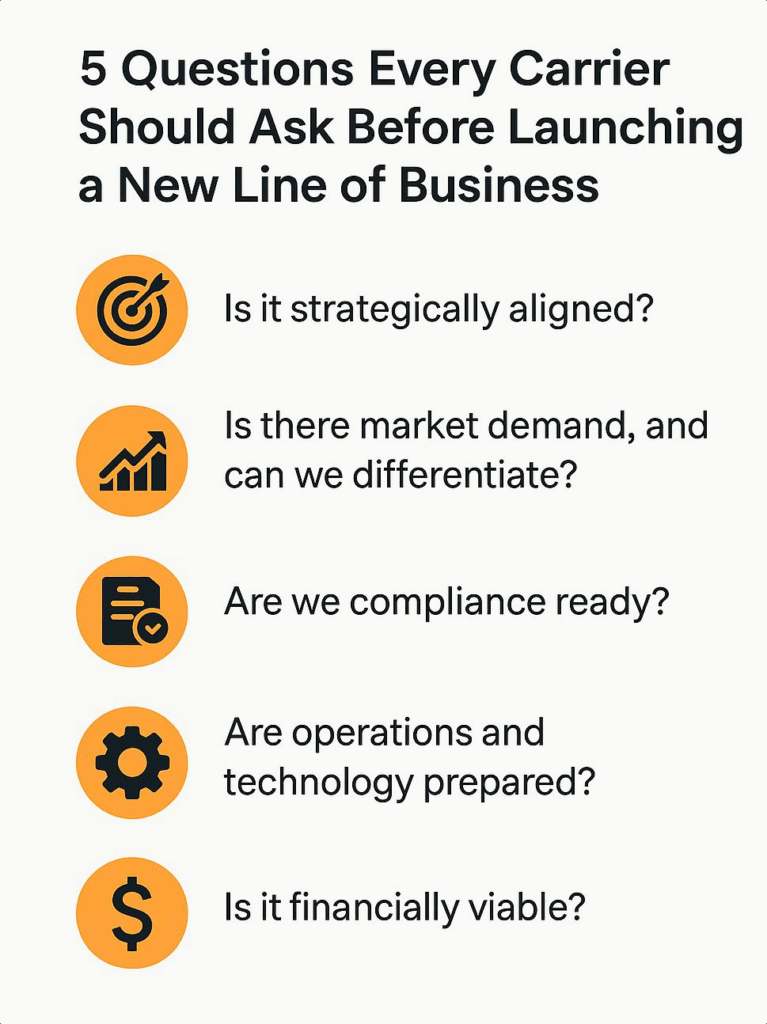
4. Can Our Operations and Technology Stack Handle It?
A product launch is more than an underwriting decision, it’s an operational test. If your systems, processes, and people aren’t ready, even the best-designed product can falter.
Key operational considerations:
- Policy administration systems must be capable of configuring new products without extensive custom development.
- Billing and claims platforms should support adaptable workflows to handle new coverage types efficiently.
- Distribution channels require the right tools, training, and resources to sell and service the new product effectively.
Modern launches often require more than just system tweaks. Straight-through processing, API integrations, and digital self-service tools are no longer “nice-to-haves” for many customers, they’re expected. These capabilities not only boost customer satisfaction, but also help carriers reduce support costs and operational bottlenecks
Example: AIG launched Blackboard Insurance in 2017 to modernize mid-market commercial coverage with AI, but progress was slow. By 2020, AIG shut it down, writing off $210M after the platform failed to deliver underwriting accuracy or efficiency. The case shows how even well-funded tech initiatives can collapse if execution falls short.
Read More: 9 Challenges P&C Insurers Face in Digital Transformation
5. Does the Business Case Hold Up Financially?
Even if the strategic, market, compliance, and operational boxes are ticked, the launch must make financial sense.
Key financial metrics:
- Expected combined ratio must align with or outperform the carrier’s target (typically below 95-100% for sustainable profitability). Projections should include both the loss ratio (claims as a % of earned premium) and the expense ratio (operating expenses as a % of written premium).
- Break-even timeline should be modeled with sensitivity tests under different scenarios (e.g., CAT losses, inflation, or slower distribution uptake). Profitability is generally expected within 3-5 years, depending on the line of business.
- Capital allocation must justify investment against the company’s hurdle rate or cost of capital. Projected ROI should exceed alternative deployments of capital, such as share repurchases, reinsurance programs, or strengthening reserves.
Carriers also need to model catastrophic exposure and inflation impacts. A 2024 report found that inflation-related claims costs increased by an average of 8% year-over-year, eating into profitability for new lines that hadn’t factored in rising repair and replacement costs.
Example: Hippo, a fast-growing home insurer, saw loss ratios surge after major CAT events, hitting 178% in Q2 2023. The company paused new business nationwide, tightened underwriting, and faced regulatory scrutiny. The case shows how aggressive growth with underpriced risk can quickly trigger financial failure.
Conclusion
These five questions aren’t just a launch checklist, they’re a litmus test for sustainable growth. By applying them early in the decision-making process, carriers can avoid costly missteps, accelerate high-potential opportunities, and strengthen internal alignment.
With Practo Insura’s insurance strategic consulting expertise, insurers gain the frameworks, market insights, and regulatory guidance needed to evaluate opportunities with confidence and bring new lines to market successfully. For carriers looking to expand intelligently, discipline is the differentiator. Asking the right questions before launch can be the difference between a product that scales profitably and one that stalls before it starts.

We specialize in developing innovative Property & Casualty (P&C) insurance software solutions, leveraging over 8 years of InsurTech expertise to simplify insurance operations and enhance efficiency.
Share Article via


Subscribe to our insights newsletter
Related Blog Posts
How to Reduce FNOL Time...
 05 Oct, 2026
A homeowner discovers a burst pipe at 11 p.m. If...
Read More

Top 9 Claims Estimator Solutions...
23 Sep, 2026
Claims estimating can involve significant manual work, from reviewing damage...
Read More

7 Signs Your P&C Insurance...
14 Aug, 2026
For U.S. P&C insurers, AI is shifting from a technology...
Read More