



The future of policyholder support in the U.S. property and casualty (P&C) insurance space is undeniably powered by automation. With rising service expectations, complex policy structures, and high support volume across multiple channels, traditional support models are no longer scalable. That’s where AI virtual agents step in, offering 24/7 intelligent assistance for everything from basic queries to claims status updates.
Why Insurance Support Needs Automation
Customer support in P&C insurance is both essential and resource intensive. Automating support interactions can reduce call center costs by up to 30%. From managing first notice of loss (FNOL) to answering billing questions and handling policy coverage checks, the burden on agents and call centers is major. As service expectations grow, insurers are under mounting pressure to deliver faster, more accurate responses without increasing costs.
This is where AI virtual agents prove invaluable. These intelligent assistants streamline high-volume support by:
- Automating repetitive queries across channels (voice, chat, SMS)
- Integrating with core systems like PAS, billing, and claims platforms
- Reducing manual workload for agents and lowering support costs
- Improving resolution times and overall policyholder satisfaction
- Maintaining compliance and consistency across jurisdictions
Top 7 AI Virtual Agents for Insurance Support
1. Zendesk AI
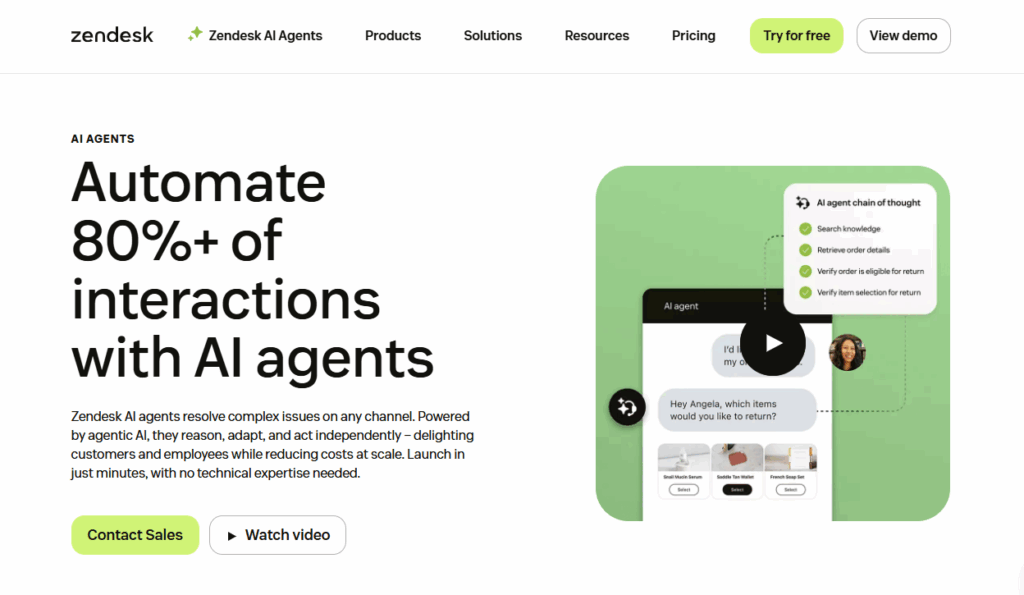
Zendesk has been known for its helpdesk infrastructure, but its evolution into AI-powered support is what makes it particularly relevant for today’s insurance landscape. With tools like Answer Bot and the broader Zendesk AI suite, it enables insurers and agencies to automate a wide range of frontline tasks without compromising compliance or control.
What sets Zendesk apart is its ability to manage high-frequency service interactions, like billing questions, document requests, or coverage clarifications, across multiple channels. It doesn’t just deflect tickets; it intelligently routes, responds, and learns, making it a powerful foundation for P&C insurers aiming to modernize support operations at scale.
Key Features:
- Omnichannel support (email, chat, messaging, voice)
- AI-powered Answer Bot with flow builder
- Smart ticket routing based on context and urgency
- Knowledge base integration for instant responses
- Real-time dashboards and conversation analytics
- Pre-trained insurance and finance intents
Pros:
- Scales easily across support teams
- Integrates well with CRMs and policy systems
- High configurability for automation rules
Cons:
- Can be costlier for smaller agencies
- Initial setup requires structured knowledge base
- Not industry-exclusive, requires some tailoring for insurance use cases
2. Practo Insura – AI Support Agents
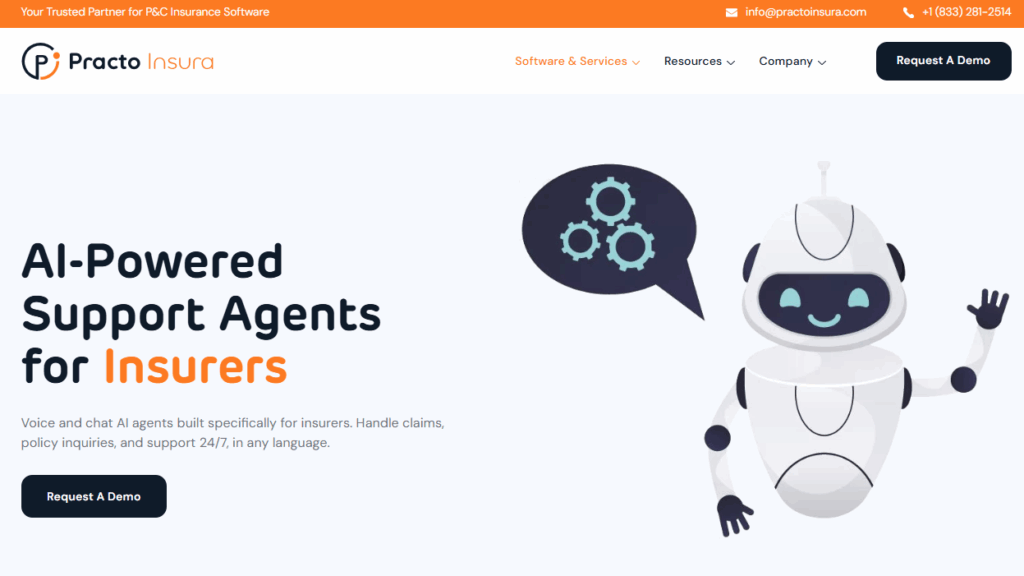
Practo Insura’s AI Support Agents are built specifically for U.S.-based P&C insurers, going far beyond the capabilities of off-the-shelf chatbots. These virtual agents are designed to operate within real insurance workflows, handling everything from renewal to FAQs with a firm grasp of regulatory details.
What makes them stand out is their deep integration with core systems like PAS, self-service portals, and claims platforms, allowing the agent to respond in context, not just from a script. It doesn’t just handle scripted queries; it engages with context, integrates with live policy data, adapts to complex workflows and routes complex queries to human support with context.
Key Features:
- Voice and chat agents for insureds and producers
- Instant quote generation
- 24/7 FNOL & Claim Submission
- Renewal nudges and lapse-risk detection
- Integration with PAS, rater, claims, and billing platforms
- Contextual memory to reduce repeat interactions
- Multilingual support and language recognition
- Configurable prompts for jurisdiction-specific rules
- Semantic analysis of queries and smart re-routing to human when needed
Pros:
- Insurance-native with deep system integration
- Reduces manual support workload
- Excellent for first-line triage and renewals
Cons:
- Focused more on insurance (not for general helpdesk)
3. Live Person
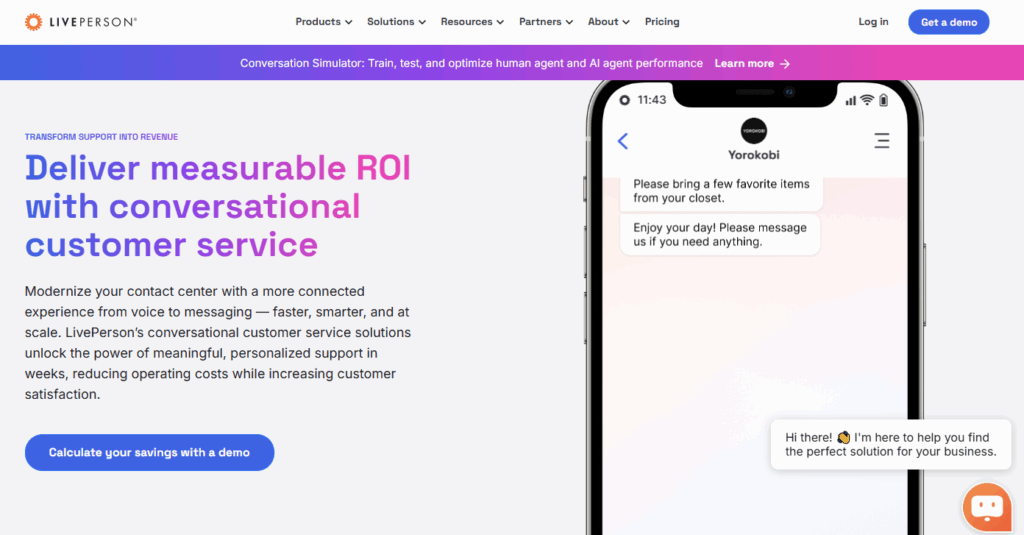
LivePerson brings enterprise-grade conversational AI to the front lines of insurance communication across SMS, WhatsApp, web chat, and even voice. What makes it especially effective for insurers is its ability to understand policyholder intent and emotional tone in real time, allowing it to respond intelligently and escalate only when needed.
Instead of just pushing templated replies, LivePerson’s AI dynamically interprets context, routes interactions based on sentiment, and integrates smoothly with claims or policy systems, giving support teams the scale of automation with the nuance of a human touch.
Key Features:
- Conversational AI bots across messaging apps
- Sentiment and intent detection
- Escalation routing to human agents when needed
- Real-time analytics with custom dashboards
- Insurance industry playbooks for faster setup
- API integration with claims and policy systems
Pros:
- Strong fit for carriers with high-volume messaging
- Flexible API-first architecture
- Excellent multi-language support
Cons:
- More enterprise-oriented (best for larger insurers)
- Setup and tuning require effort and governance
- May over-serve smaller agencies’ needs
4. Sonant AI
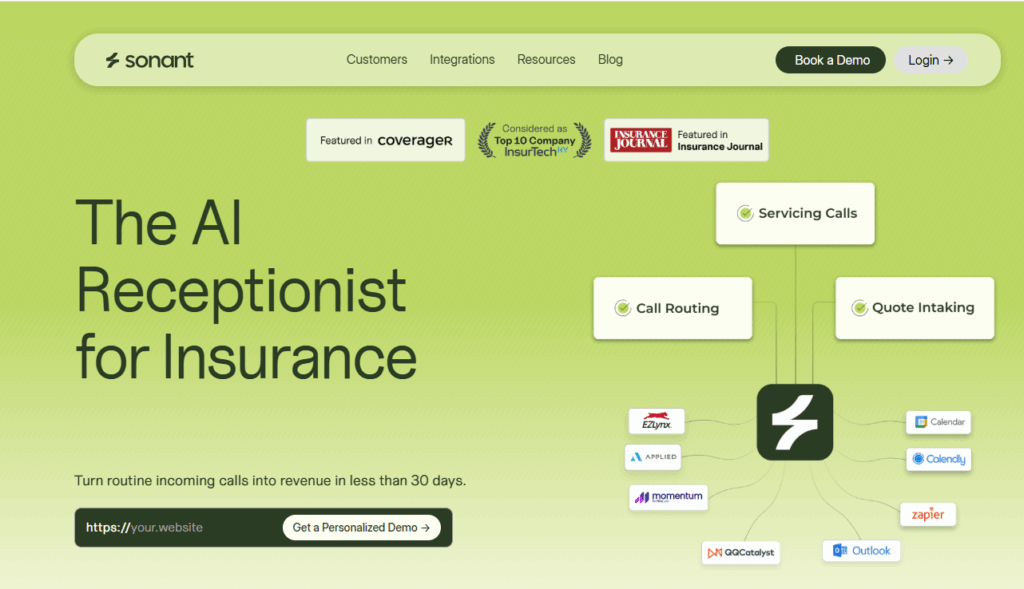
Sonant AI is purpose-built for insurance agencies in the U.S., acting as a 24/7 virtual receptionist. It’s designed to handle the high call volume typical of local agencies, capturing lead details, answering policy questions, and routing urgent issues, without needing full-time staff on standby.
What sets it apart is its insurance-trained voice AI, which understands industry-specific queries and can engage with callers just like a front-desk team member. Whether it’s a prospect asking for a quote or a client checking on their policy, Sonant ensures your phone lines are always responsive, even after hours.
Key Features:
- Insurance-trained AI voice receptionist
- Handles coverage questions, policy status, claims inquiries
- Call scheduling and contextual ticket transfer capabilities
- AMS (Application Management System)-friendly workflow integration
- Web-based call dashboard with transcripts
Pros:
- Built specifically for insurance agents
- Affordable for small to midsize agencies
- Reduces missed leads and service load
Cons:
- Works best with AMS integration
- Not designed for carrier-scale operations
5. Hi Marley
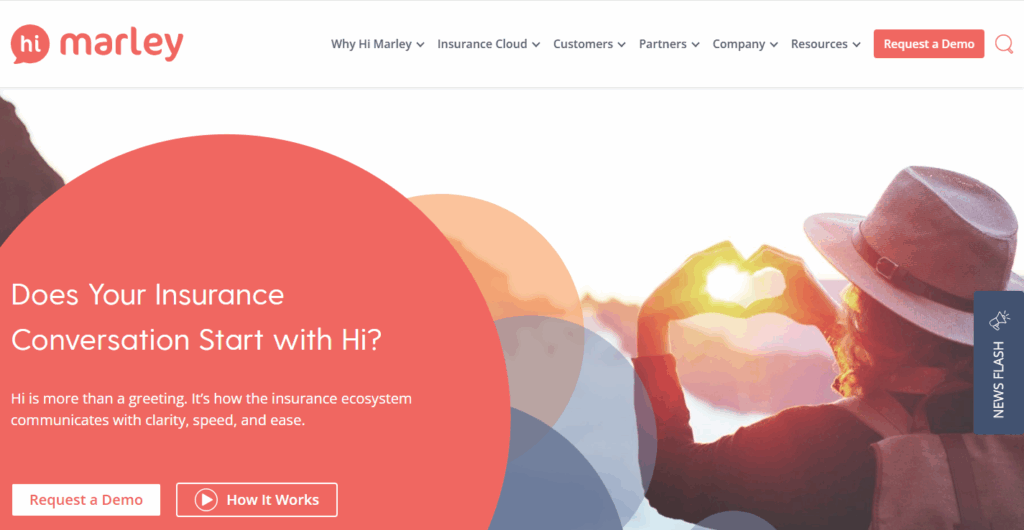
Hi Marley is built exclusively for the insurance industry, offering a text-first communication platform that bridges the gap between policyholders, agents, and adjusters. It’s not just texting; it’s a compliant, multi-party messaging system tailored for claims and service workflows.
The platform supports real-time, two-way conversations in over 19 languages and seamlessly integrates with core systems. It is for insurers looking to streamline claims updates, reduce phone traffic, and keep all parties in sync.
Key Features:
- SMS-first platform with 19+ languages
- Multi-party texting (policyholder + agent + adjuster)
- Smart escalations and AI message tagging
- Secure, SOC2-compliant communications
- Real-time audit trails and reporting
Pros:
- Insurance-specific, highly focused
- Great for claims and field adjuster teams
- Supports collaborative messaging across roles
Cons:
- Primarily chat-based, less versatile on voice
- Requires core system integration for best use
- May not replace full-service support centers
6. Cloud Talk
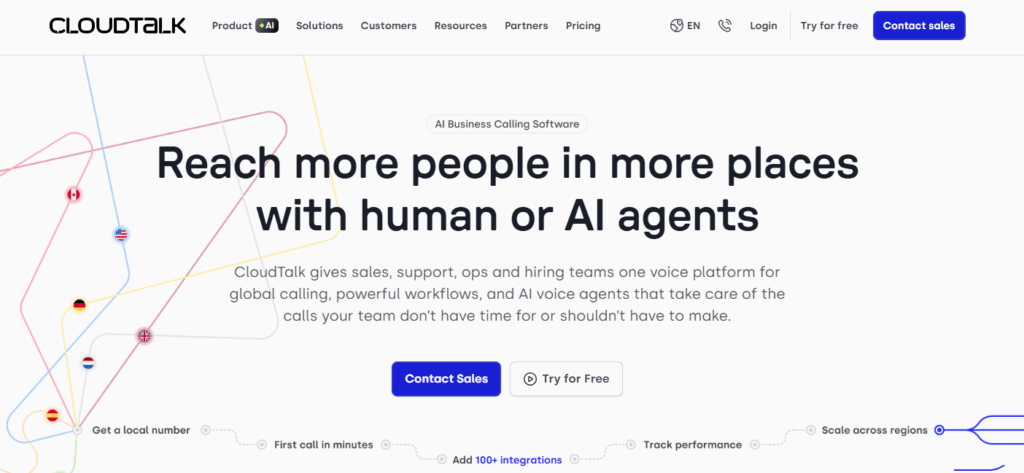
CloudTalk is a cloud-native call center platform that provides AI -powered voice support to insurance agents. While it’s used across multiple industries, its smart call routing, live transcriptions, and real-time analytics make it especially valuable for insurers managing complex, high-volume phone interactions.
What makes Cloud Talk stand out is how seamlessly it integrates with CRMs and helpdesk tools, enabling insurers to prioritize calls based on customer type, policy status, or urgency. It’s a strong fit for support teams that rely heavily on voice but still want the automation and insights typically found in chat-based systems.
Key Features:
- Smart IVR (Interactive Voice Response) and call routing based on caller profile
- Real-time transcription and call summaries
- Sentiment analysis and agent scoring
- Call recordings and QA tools
- CRM integrations
- Easy VoIP setup across distributed teams
Pros:
- Excellent voice support automation
- Strong analytics and agent performance tools
- Ideal for hybrid or remote support teams
Cons:
- Not insurance-specific by default
- Requires customization for policy/claim logic
- No built-in chat or messaging automation
7. Client Circle
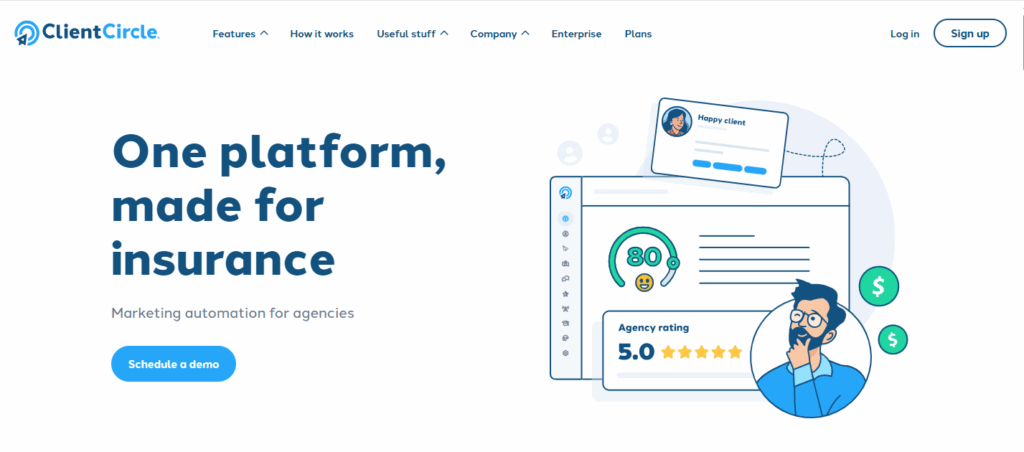
Client Circle is designed for insurance agencies that want to go beyond reactive service and build long-term client relationships through smart, automated communication. It’s not a chatbot or virtual assistant in the traditional sense, but it uses AI to anticipate client’s needs and deliver support before a ticket is ever opened.
By analyzing client behavior, sentiment, and policy milestones, Client Circle’s AI helps agencies send timely reviews, reminders, and check-ins that feel personal, without requiring daily manual effort. It turns routine touchpoints into proactive service moments that improve retention and reduce inbound workload over time.
Key Features:
- Reviews, referrals, and NPS tracking
- Text and email campaigns to clients
- AI-powered retention journey builder
- Merge fields for personalized messages
- Agency branding and message timing optimization
Pros:
- Excellent for building long-term retention
- Adds support value without live staff
- Simple to use and agency-friendly
Cons:
- Not real-time chat or voice support
- Focused more on marketing than service
- Limited escalation or workflow capabilities
Comparison Matrix of AI Support Platforms
| Tool | Best For | Support Type | Integrations | AI Capabilities |
|---|---|---|---|---|
| Zendesk AI | Carriers & agencies needing full helpdesk support | Chat, email, voice, ticketing | CRM, ticketing, knowledge base | Answer Bot, smart routing, flow builder |
| Practo Insura | Insurers needing policyholder facing voice/chat support agents | AI-powered Voice & chat | PAS, rater, claims, billing systems | Sentiment detection, intent modeling, Escalation routing, multilingual AI |
| LivePerson | High-volume messaging for carriers/TPAs | SMS, chat, WhatsApp, web | Policy systems, CRM, messaging APIs | Sentiment detection, intent modeling |
| Sonant AI | Independent agencies needing 24/7 phone handling | Voice receptionist | AMS, voice dashboard | Insurance-intent trained voice bot |
| Hi Marley | Claims follow-ups via SMS (carriers & adjusters) | SMS-based multi-party texting | PAS system, SMS APIs | Text automation, language detection |
| Cloud Talk | Voice-based support teams (agencies/carriers) | Call center/VoIP, IVR | CRM, VoIP, analytics tools | Call summaries, IVR, sentiment |
| Client Circle | Agencies focused on retention & CX automation | Automated texts/emails | AMS, CRM, text/email services | Campaign automation, NPS tracking |
Conclusion
AI virtual agents in P&C insurance aren’t just a cost-cutting play, they’re becoming essential to how modern insurers deliver speed, consistency, and real value to policyholders. Whether you’re a national carrier managing thousands of claims or a lean agency juggling service calls, AI can help you work smarter, not just harder.
From enterprise-grade platforms like Zendesk and LivePerson, to insurance-first tools like Practo Insura , Sonant, and Hi Marley, there’s no one-size-fits-all answer, only the right fit for your operational reality. The smartest move is choosing a solution that aligns with your tech stack, supports your teams, and keeps pace with your customers’ rising expectations.

We specialize in developing innovative Property & Casualty (P&C) insurance software solutions, leveraging over 8 years of InsurTech expertise to simplify insurance operations and enhance efficiency.
Share Article via


Subscribe to our insights newsletter
Related Blog Posts
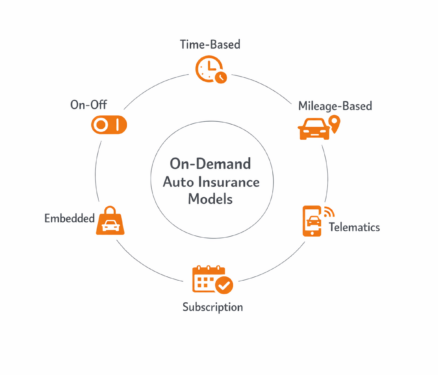
6 Types of On Demand...
 27 Feb, 2026
For decades, personal auto insurance has been built around the...
Read More
How to Build Right Customer...
19 Feb, 2026
In today’s U.S. property & casualty (P&C) insurance landscape, customer...
Read More
How to Build Right Compliance...
02 Feb, 2026
Insurance leaders often ask: “Why are our filings taking so...
Read More