



Claims estimating can involve significant manual work, from reviewing damage photos and identifying repair needs to checking costs and preparing an estimate. As claim volumes grow, these steps can slow the process and increase pressure on claims teams.
Claims estimator technology helps automate parts of this work by analyzing claim data, images and pricing information to support damage assessment, repair scoping and estimate creation.
For P&C insurers, the market now includes established platforms such as CCC, Xactimate and Mitchell, as well as newer AI tools that support photo-based assessments, remote inspections and integration with existing claims systems.
Not all of these solutions work in the same way. Some generate detailed estimates, while others provide damage assessments or initial scopes for adjuster review.
In this guide, we compare nine claims estimator solutions across auto and property insurance, including their capabilities, integrations and level of human involvement.
Quick Comparison of Claims Estimator Solutions
The solutions below differ in the claims they support, how they are deployed and how much of the estimating process they handle.
| Solution | Claims Type | Main Capability | Deployment | Human Involvement |
|---|---|---|---|---|
| CCC Intelligent Solutions | Auto | AI-assisted line-item estimating and straight-through estimating for eligible claims | CCC platform | Smart Estimate supports appraiser review; Estimate-STP can automate eligible claims |
| Practo Insura | Auto & Property | AI-assisted damage assessment and estimated claim information | Platform / Integration | Adjuster reviews and can revise estimates |
| Mitchell / Enlyte | Auto | AI-assisted component identification and line-item estimating | Cloud estimating platform | Appraisers can review, complete and approve estimates |
| Tractable | Auto & Property | Computer vision damage assessment and estimate support | API / Web integration layer | Depends on carrier workflow and level of automation |
| Ravin AI | Auto | Remote vehicle inspection, damage assessment and repair-cost calculation | API / Mobile / Web | Depends on insurer workflow |
| Hosta AI | Property | Remote interior assessment, measurements, scoping and estimating support | API / Assessment platform | Depends on how outputs are used within the estimating workflow |
| Verisk Xactimate | Property | Line-item property estimating with localized pricing and AI assistance | Desktop / Online / Mobile | Users can review, edit or override AI recommendations |
| Cotality Claims Estimate | Property | Property estimating, LiDAR scoping and AI-assisted voice-to-line-item input | Desktop / Mobile | Adjuster-led with AI and automated validation support |
| Solera Qapter / Audatex | Auto | AI-assisted damage detection, line-item estimating and total-loss support | Modular cloud platform | Supports automated workflows with appraiser review where required |
3 Platform-Native Claims Estimating Solutions
These solutions provide estimating as part of a broader claims platform, allowing insurers to connect damage assessment, estimate creation and other claims activities within the same environment.
1. CCC Intelligent Solutions
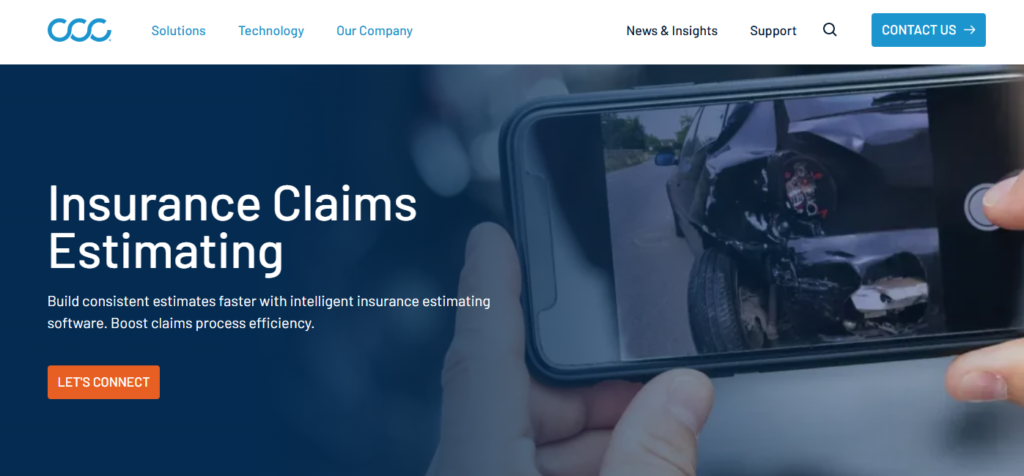
CCC Intelligent Solutions is widely used across the U.S. auto claims ecosystem, connecting insurers with repair facilities, parts suppliers and other participants involved in the claims process.
For estimating, CCC offers Smart Estimate and Estimate-STP, which support different levels of automation. Smart Estimate applies CCC’s estimating logic and AI to collision photos to identify likely repair requirements and recommend estimate lines. It is designed to guide appraisers through the estimating process, while insurers can configure estimating parameters and business rules around their own requirements.
Estimate-STP extends automation further by allowing eligible claims to move through a straight-through estimating workflow. Carriers can define rules and eligibility thresholds that determine which claims can be handled automatically and which require adjuster review.
Because these capabilities operate within CCC’s broader auto claims environment, estimating can connect with other activities such as repair facility assignment, parts sourcing and total-loss handling.
Key Strengths
- Strong presence across the U.S. auto claims ecosystem
- Supports both AI-assisted and straight-through estimating workflows
- Allows insurers to configure business rules and claim eligibility criteria
- Connects estimating with other auto claims processes
Considerations
- Focused primarily on auto physical damage
- Smart Estimate supports appraisers rather than operating as a fully touchless estimating process
- Straight-through processing depends on carrier-defined rules and claim eligibility
Claims supported: Auto physical damage
Input: Collision photos, VIN and claim data
Output: Repair requirements and line-level estimate recommendations
Deployment: CCC platform
Human involvement: Smart Estimate supports appraiser review, while eligible claims can use Estimate-STP for straight-through processing
Best suited for: U.S. auto insurers looking to combine AI-assisted estimating with configurable automation within a broader claims ecosystem
2. Practo Insura
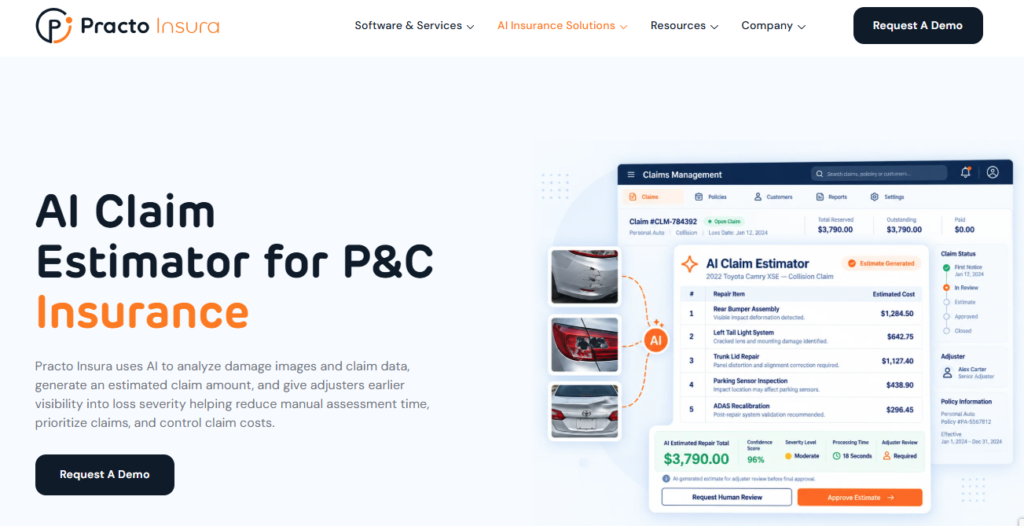
Practo Insura provides AI-assisted claims estimation for P&C insurers across both auto and property claims, giving carriers more flexibility than solutions focused on a single line of business. It can be used within Practo Insura’s claims platform or integrated into an insurer’s existing core environment, making it suitable for carriers that want to add AI without necessarily replacing their current claims system.
The estimator analyzes damage images and claim data to identify affected components, reference repair or replacement costs, and generate an estimated claim amount with an AI-generated damage summary. Rather than treating the estimate as a final automated decision, the system gives adjusters a structured starting point that they can review and refine.
Adjusters can revise estimates before the claim progresses, while estimate versioning keeps a record of previous and updated amounts, dates and user changes. This helps combine faster AI-assisted estimation with the control and traceability claims teams still need.
Key Strengths
- Supports both auto and property claims
- Can work within Practo Insura Claims or alongside an existing core system
- Keeps adjusters in control of final estimate review
- Supports estimate version history and auditability
- Can be configured around carrier-specific claims workflows rather than forcing a fixed process
Considerations
- Implementation is tailored to insurer requirements rather than provided as a fixed off-the-shelf package
- Integration scope depends on the carrier’s existing systems and workflow requirements
Claims supported: Auto and property
Input: Damage images and claim data
Output: Estimated claim amount and AI-generated damage summary
Deployment: Practo Insura platform or integration with an existing core system
Human involvement: Adjuster reviews and can revise the estimate before the claim moves forward
Best suited for: P&C carriers, MGAs and specialty insurers that want AI-assisted estimation with greater workflow flexibility and adjuster control
3. Enlyte / Mitchell
Mitchell, part of Enlyte, provides auto physical damage estimating technology for insurers and repair organizations. Its broader estimating environment includes Mitchell Cloud Estimating, while its AI-assisted estimating capability is branded Mitchell Intelligent Estimating.
At the core of the AI workflow is Mitchell Intelligent Damage Analysis, which uses computer vision to evaluate vehicle damage images, identify affected components and recommend repair operations. These recommendations can then be mapped to individual estimate lines and incorporated into the estimating process.
One of Mitchell’s strongest differentiators is its open architecture. Carriers can use Mitchell’s own AI capabilities or connect third-party computer vision providers, giving insurers more flexibility in how they build their estimating workflow. Estimate data can also be exchanged using CIECA BMS standards, helping support interoperability with other claims systems.
Key Strengths
- Strong focus on auto physical damage estimating
- AI recommendations can support line-item estimate creation
- Open architecture allows third-party AI integration
- Supports CIECA BMS data exchange
- Gives carriers flexibility in how AI is incorporated into their estimating workflow
Considerations
- Primarily focused on auto rather than property claims
- Workflow complexity may increase when multiple third-party AI tools are integrated
- The final level of automation depends on carrier configuration and connected technologies
Claims supported: Auto physical damage
Input: Vehicle damage photos and claim information
Output: Component-level repair recommendations and estimate lines
Deployment: Cloud-based estimating platform
Human involvement: Appraisers can review, complete and approve AI-assisted estimates
Best suited for: Auto insurers that want an established estimating platform with flexibility to integrate their preferred AI technologies
3 Standalone AI Claims Assessment Solutions
These tools focus on AI-driven damage analysis, remote inspection or image-based assessment and typically feed their outputs into an insurer’s existing claims or estimating system.
4. Tractable
Tractable uses computer vision to analyze damage images across both auto and property claims. Rather than functioning only as a standalone estimating platform, it is designed to work as an AI layer that can support and enhance an insurer’s existing claims and estimating environment.
Its technology can support several stages of the claims process, including FNOL triage, damage assessment, estimate pre-population, and estimate review. For auto claims, Tractable can analyze collision photos and help generate a partial or complete estimate that can flow into an established estimating workflow.
On the property side, policyholders can submit damage photos through a web-based experience. Tractable’s AI can identify, classify and measure damage, with the resulting information used to support estimate generation within systems such as Xactimate.
A major strength is its integration model. Tractable works with established platforms including Mitchell for auto and Verisk Xactimate for property, allowing insurers to introduce AI-driven image analysis without replacing their existing estimating systems.
Key Strengths
- Supports both auto and property claims
- Strong focus on computer vision and image-based damage assessment
- Can support estimate pre-population and review
- Integrates with established estimating platforms such as Mitchell and Xactimate
- Allows insurers to add AI capabilities without replacing their current estimating environment
Considerations
- Often works alongside another estimating platform rather than replacing it
- Final estimating workflow depends on the carrier’s existing systems and integrations
- Level of automation varies depending on implementation and claim type
Claims supported: Auto and property
Input: Damage photos submitted by policyholders, repair facilities or adjusters
Output: Damage assessment, estimate inputs, repair recommendations and review support
Deployment: API and web-based integration layer
Human involvement: Depends on carrier workflow and level of automation
Best suited for: Insurers that want to add AI-powered image analysis and estimation support while retaining their existing estimating platforms
5. Ravin AI
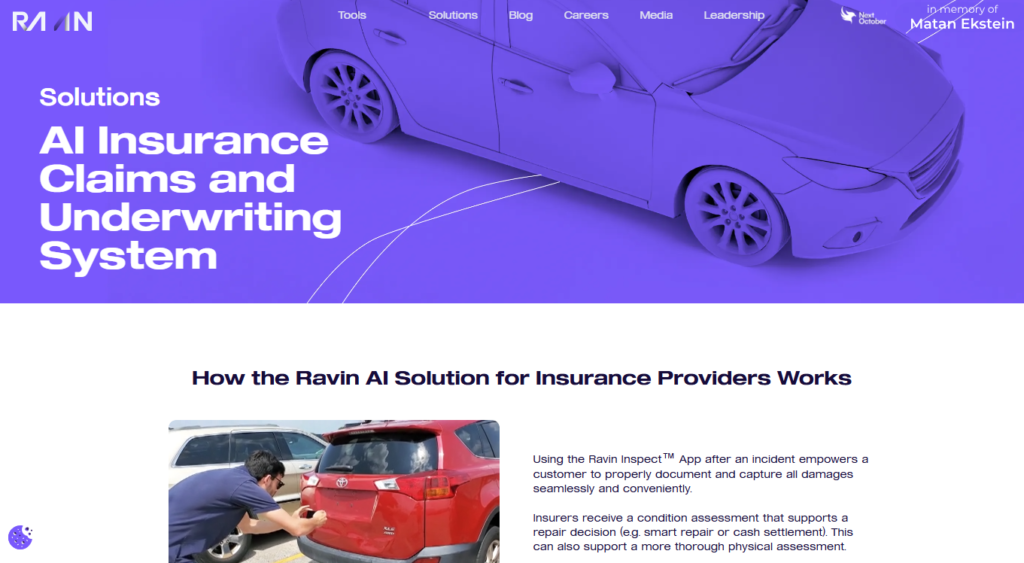
Ravin AI focuses on vehicle inspection and damage assessment for auto claims, using computer vision to analyze photos and video captured from claimants, tow operators or other users in the field.
Its workflow starts with guided image capture. RAVIN Inspect allows users to submit vehicle photos or video from a mobile device without installing a dedicated app, while RAVIN Eye supports damage review, repair-versus-total-loss triage and repair cost calculation.
The results can then be passed into the insurer’s existing claims environment through APIs. This makes Ravin particularly relevant for carriers that want to improve remote vehicle inspection and early claims triage without replacing their broader claims management system.
Key Strengths
- Combines guided vehicle capture with AI-based damage assessment
- Supports photo and video submission without requiring a dedicated app
- Can support repair cost calculation and total-loss triage
- API-based architecture supports integration with existing claims systems
- Useful for remote inspection and early-stage claims handling
Considerations
- Focused on auto claims rather than property
- Estimating is closely linked to vehicle inspection and capture workflows
- Final use of the AI output depends on the insurer’s claims process and integration setup
Claims supported: Auto
Input: Guided mobile photos and video
Output: Damage assessment, repair cost calculation, triage and total-loss recommendation
Deployment: API with mobile/web capture tools
Human involvement: Depends on the insurer’s claims workflow
Best suited for: Auto insurers and mobility businesses looking to combine remote vehicle inspection with AI-supported claims assessment
6. Hosta AI
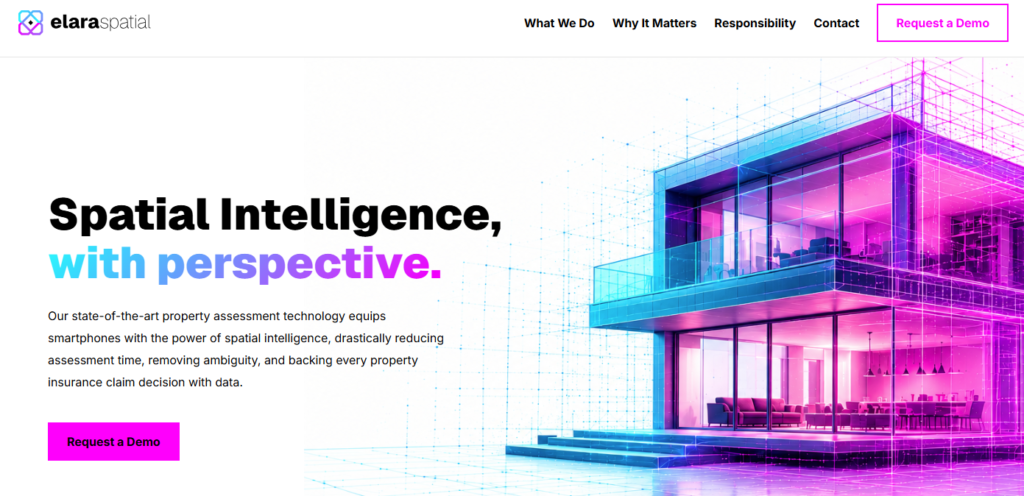
Hosta AI focuses on property claims, particularly interior damage assessment and remote property documentation. Policyholders or field users can capture a small set of room images, which Hosta analyzes to generate measurements, material details, damage information and structured property data.
The platform can produce floor plans, 3D measurements, elevations and Xactimate Sketch output. Hosta has also positioned its technology as capable of supporting completed estimates, rather than only providing preliminary scoping information.
This makes Hosta useful for insurers looking to reduce reliance on physical interior inspections while still feeding structured data into established estimating workflows. Its integrations are not limited to Xactimate alone, with support also extending into other claims and estimating environments.
Key Strengths
- Built specifically for interior property claims
- Can reduce the need for on-site property inspections
- Generates measurements, floor plans, elevations and 3D property data
- Supports Xactimate Sketch generation
- Can contribute to completed estimating workflows, not only preliminary scoping
- Designed to integrate with established claims and estimating systems
Considerations
- Focused primarily on property rather than auto claims
- The final workflow depends on the estimating platform and carrier implementation
- Insurers should evaluate how Hosta’s generated estimate or assessment data fits into their existing review process
Claims supported: Property
Input: Interior property photos
Output: Damage assessment, measurements, floor plans, elevations, 3D data, Xactimate Sketch and estimating information
Deployment: API / assessment platform
Human involvement: Depends on how the insurer incorporates Hosta output into its estimating and review workflow
Best suited for: Property insurers looking to automate interior assessment, reduce site visits and feed structured property data into established estimating systems
3 Established Claims Estimating Systems
These are mature estimating platforms built around repair, construction or pricing data, with newer AI and automation capabilities being added to support existing estimating workflows.
7. Verisk Xactimate
Verisk Xactimate is one of the most established property claims estimating platforms in the U.S. and Canada. It is built around localized pricing data for materials, labor and repair activities, helping adjusters create detailed line-item estimates based on the scope and location of a loss.
The platform works across desktop, online and mobile environments and connects with XactAnalysis for assignment, estimate exchange and broader claims workflow management. Verisk researches pricing across more than 460 localized markets in the U.S. and Canada, giving estimators location-specific cost information when building property estimates.
Verisk has also expanded its AI capabilities through XactAI. These features can support line-item recommendations, automatic photo labeling and descriptions, note summarization and floor plan capture through Sketch Scan. AI-generated output is still designed to support human decision-making, with users able to review, edit or override recommendations.
Key Strengths
- Established property claims estimating ecosystem
- Detailed line-item estimates supported by localized pricing data
- Pricing research across more than 460 U.S. and Canadian markets
- AI can support line-item recommendations, documentation and floor plan capture
- Broad integration ecosystem through XactAnalysis and third-party technologies
- Human review remains part of the estimating process
Considerations
- Focused mainly on property rather than auto claims
- Works best within the wider Xactimate and XactAnalysis ecosystem
- AI capabilities assist the estimating process rather than replacing adjuster judgment
Claims supported: Property
Input: Adjuster scope, photos, sketches, floor plan data and other property information
Output: Detailed line-item property estimate
Deployment: Desktop, online and mobile
Human involvement: Users can review, edit or override AI-generated recommendations
Best suited for: Property insurers, adjusting firms and restoration organizations that need detailed estimating supported by localized pricing data and an established claims ecosystem
8. Cotality Claims Estimate
Cotality Claims Estimate, formerly known as Symbility Mobile Claims under CoreLogic, is a property estimating platform built for both field and desk-based claims workflows. It combines structured estimating tools with construction pricing data to help claims teams create detailed property repair estimates.
The platform supports guided estimating, photo capture, diagramming and LiDAR-based room scanning on supported iOS devices. Cotality also promotes an AI-powered voice engine that can convert spoken descriptions of property damage into estimate line items, helping adjusters capture information more quickly while working in the field.
Claims Estimate sits within Cotality’s broader property claims environment, alongside tools for inspection, scoping, workflow management and estimate validation. This allows insurers to connect estimating with other parts of the property claims process rather than treating it as a separate activity.
Key Strengths
- Built specifically for property claims estimating
- Supports both desktop and mobile workflows
- Includes LiDAR-based room scanning for field scoping
- AI-powered voice input can help convert spoken damage descriptions into line items
- Uses construction pricing data to support detailed estimates
- Connects with a broader suite of property claims tools
Considerations
- Focused on property rather than auto claims
- The estimating workflow remains adjuster-led even with newer AI assistance
- Insurers should evaluate how the broader Cotality claims suite fits with their existing systems
Claims supported: Property
Input: Adjuster scope, photos, diagrams, LiDAR scans and voice input
Output: Detailed line-item property estimate
Deployment: Desktop and mobile
Human involvement: Adjuster-led, with AI and automated validation supporting the estimating process
Best suited for: Property insurers and adjusting firms looking for mobile-first estimating, field scoping tools and AI-assisted workflow support
9. Solera Qapter / Audatex
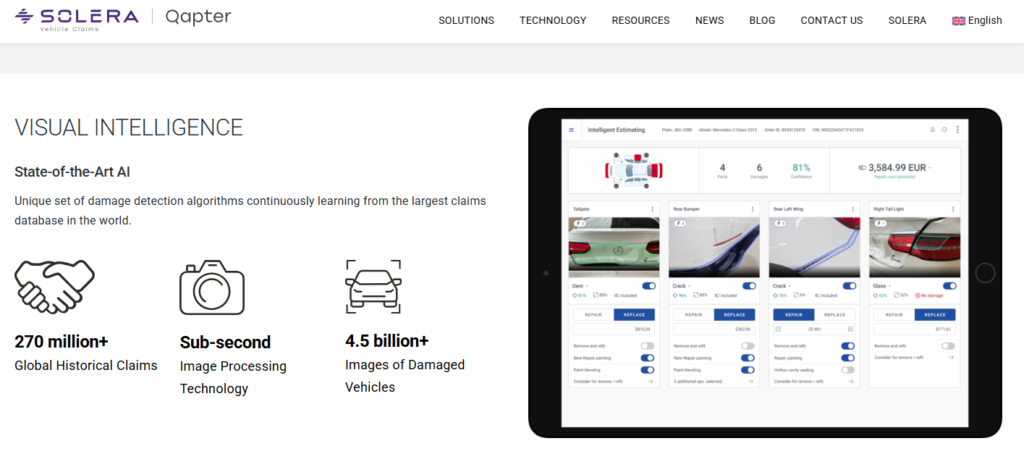
Solera Qapter is an AI-assisted auto claims estimating solution designed to support the process from damage capture through estimating and settlement. It uses image analysis to identify damaged vehicle parts, assess damage severity and recommend repair operations that can be translated into line-item estimates.
The platform combines AI with Solera’s vehicle and repair data to support repair planning, estimating, triage and total-loss workflows. Solera positions the AI as a tool that complements human expertise, allowing appraisers or claims teams to review and adjust estimates when required.
Qapter is offered as a modular cloud-based suite, so insurers can use individual capabilities or combine them into a broader auto claims workflow. Solera has also expanded the platform with Qapter Direct Dispatch, which adds AI-assisted damage estimating and automated vehicle equipment identification to help move claims more efficiently from intake into the estimating process.
Key Strengths
- Strong focus on auto physical damage estimating
- Uses AI for damage detection, parts identification and repair recommendations
- Supports line-item estimates, triage and total-loss workflows
- Modular architecture allows insurers to select specific capabilities
- Qapter Direct Dispatch adds AI-assisted estimating earlier in the claims process
- Supports workflows where human appraisers can review and adjust AI-generated estimates
Considerations
- Focused on auto rather than property claims
- The level of automation depends on the modules and workflow used
- Human review may still be required depending on carrier requirements
Claims supported: Auto physical damage
Input: Vehicle damage photos, VIN and claim data
Output: Damage assessment, repair operations, line-item estimate and total-loss support
Deployment: Modular cloud platform
Human involvement: AI can support automated workflows, with appraiser review available where required
Best suited for: Auto insurers looking for AI-assisted estimating within a modular claims workflow that can support both automation and human review
How Claims Estimation Solutions Differ
Claims estimator solutions do not all play the same role in the claims process. Some are built directly into broader claims platforms, others work as AI layers that support an existing estimating system, and some are long-established estimating tools that are gradually adding more automation.
Platform-Native Estimating
Solutions such as CCC, Practo Insura and Mitchell place estimating within a broader claims environment. This can help insurers connect damage assessment and estimate creation with other workflows such as claim handling, repair management, total-loss processing or adjuster review.
Standalone AI Assessment
Tools such as Tractable, Ravin AI and Hosta AI focus more heavily on image analysis, remote inspection and damage assessment. They are often used alongside an insurer’s existing claims or estimating platform rather than replacing it completely.
Established Estimating Systems
Platforms such as Verisk Xactimate, Cotality Claims Estimate and Solera Qapter are built around established estimating workflows, pricing data and repair or construction information. AI and automation are increasingly being added to these systems to support faster scoping, line-item recommendations and more efficient estimate preparation.
For insurers, the main question is therefore not only which vendor offers the most features, but which type of estimating model fits the existing claims environment, line of business and desired level of automation.
Conclusion
Claims estimation technology now covers a wide range of approaches, from established estimating platforms to AI-driven assessment tools and more configurable claims systems.
For insurers, the right choice depends on more than the amount of AI a platform uses. The more important questions are whether the solution supports the right line of business, fits the existing claims environment, produces the type of estimate or assessment required, and gives claims teams the appropriate level of human oversight.
Auto carriers may prioritize vehicle damage analysis, repair estimating and total-loss workflows, while property insurers may place more emphasis on scoping, measurements, construction pricing and remote inspections. Some insurers may need a complete estimating platform, while others may be better served by adding an AI layer to systems they already use.
For carriers looking for a more configurable approach across auto and property claims, Practo Insura provides AI-assisted claims estimation that can be built around existing workflows and integrated with the broader claims environment.

We specialize in developing innovative Property & Casualty (P&C) insurance software solutions, leveraging over 8 years of InsurTech expertise to simplify insurance operations and enhance efficiency.
Share Article via


Subscribe to our insights newsletter
Related Blog Posts
7 Signs Your P&C Insurance...
 14 Aug, 2026
For U.S. P&C insurers, AI is shifting from a technology...
Read More
Insurance Underwriting Automation: Implementation Guide...
12 Jun, 2026
Most P&C underwriters did not join the industry to chase...
Read More

Why Claims Data Matters in...
03 Jun, 2026
Claims data has traditionally been treated as a record of...
Read More