


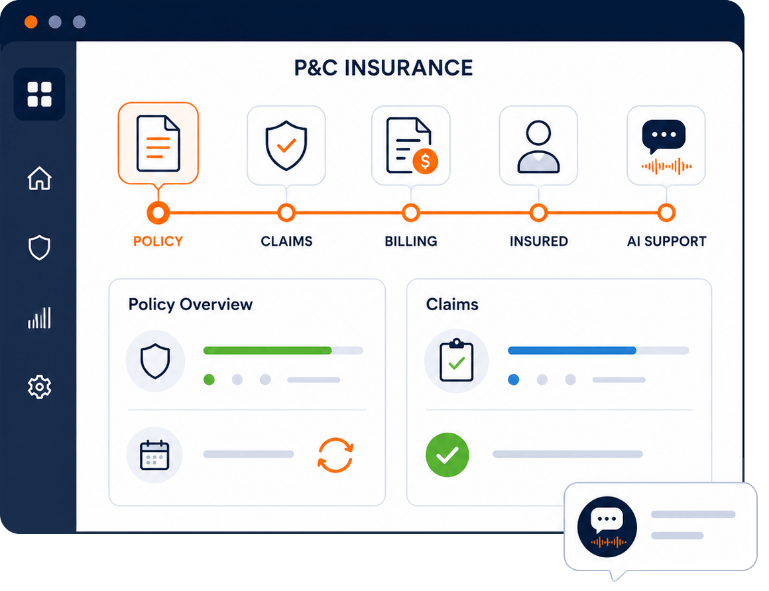
P&C Insurance Software, AI & Consulting Solutions
Practo Insura helps U.S. P&C carriers and MGAs modernize insurance operations with core software, AI-powered automation, and strategic consulting.
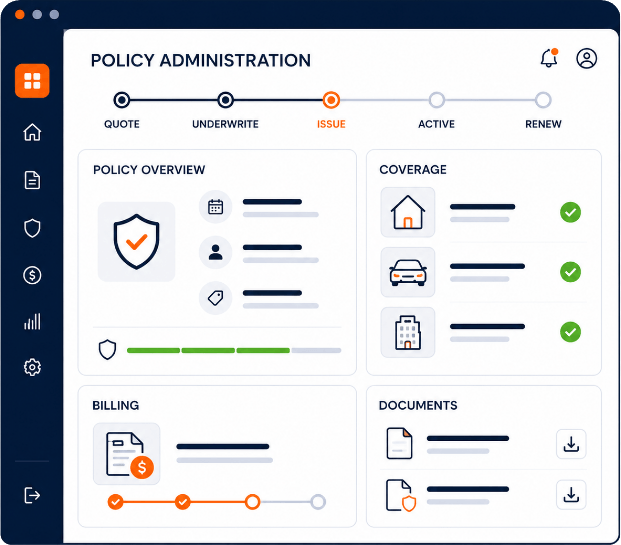
Policy Administration System
Manage the policy lifecycle from quote and bind through issuance, endorsements, renewals, billing, and servicing with a configurable P&C policy administration system that streamlines workflows and supports evolving insurance products.
- Products, rating & underwriting rules
- Policy, billing & document workflows
- APIs & third-party data connectivity
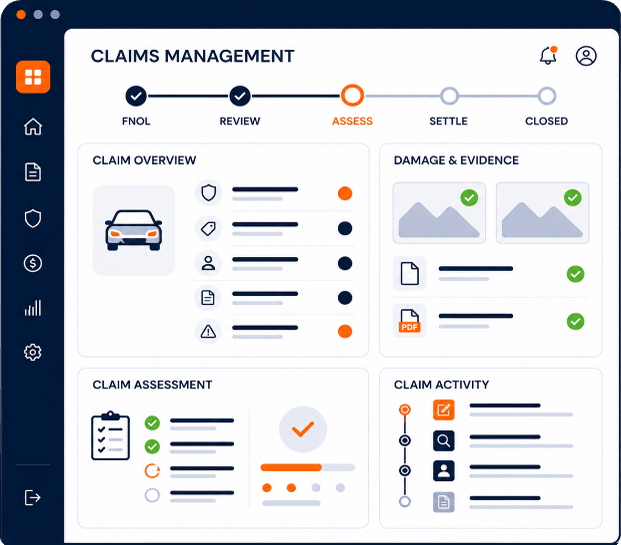
Claims Management Software
Manage claims from First Notice of Loss (FNOL) through assessment, reserves, payments, recovery, and closure with claims management software that improves visibility, process control, and efficiency throughout the claims lifecycle.
- Rules-based assignment & workflow automation
- Reserves, payments & settlement management
- Subrogation & recovery
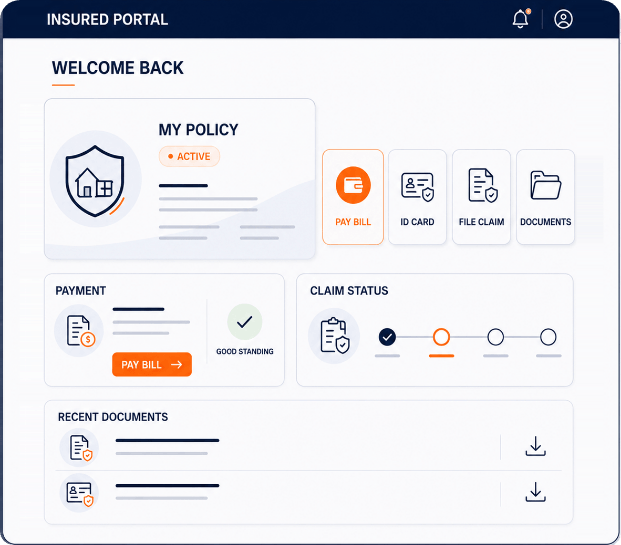
Insured Portal
Give policyholders secure self-service access to policy information, documents, billing, payments, and claims through a digital insured portal that simplifies everyday interactions and reduces manual effort for routine service requests.
- Real-time policy access & updates
- Secure online payments
- Centralized document access
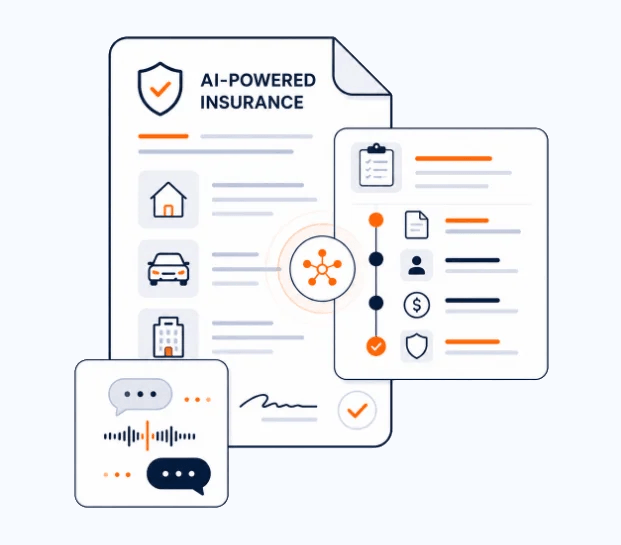
AI Solutions for Insurance
Apply AI across underwriting, claims, servicing, and insurance operations with data analytics, quote creation, claims estimation, document validation, and AI-powered chat and voice agents that automate repetitive tasks and support faster decisions.
- Insurance-specific AI workflows
- Document & data intelligence
- Conversational AI across voice & chat
- API-ready for existing insurance systems
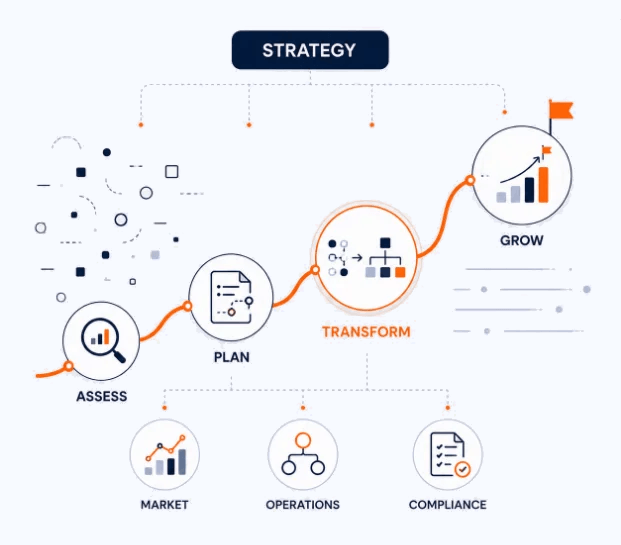
Strategic Consulting for P&C Insurance
Work with P&C insurance and technology specialists on product strategy, process improvement, system modernization, technology planning, and operational initiatives to align technology decisions with business priorities and address complex insurance challenges.
- Go-to-market & growth strategy
- Risk, capital & reinsurance advisory
- Regulatory & compliance strategy
- InsurTech modernization & implementation
Built for Reliable P&C Insurance Operations

Launch New Rates in 15 Days
Bring approved rate changes into production in as little as fifteen days, helping insurance teams respond faster to product updates, rating changes, and evolving business requirements.

Simplify Legacy Policy Data Migration
Move policy data from legacy systems through a structured migration process designed to preserve critical information, reduce disruption, and support a smoother transition to modern P&C insurance technology.

Keep Core Operations Available
Maintain dependable access to policy, claims, servicing, and other critical workflows with a verified 99.9% SLA designed to support the reliability expected from core insurance technology.
Why Choose Practo Insura?
-

P&C Expertise
Work with a team that understands P&C insurance operations, from policy administration and underwriting to claims, servicing, and the technology behind these workflows.
-

Technology + Consulting
Combine insurance technology with strategic consulting to align systems, processes, and technology decisions with your operational priorities and business goals.
-

Product Flexibility
Configure insurance products, business rules, rates, and workflows around evolving requirements, giving carriers and MGAs greater flexibility as their operations change.
-

Integration Ready
Connect with existing insurance systems and third-party services through APIs and integrations, helping data flow across workflows without replacing every part of your technology ecosystem.
Built for P&C Insurance Organizations
Practo Insura supports U.S. P&C carriers, MGAs, and InsurTech companies with technology and strategic expertise tailored to different insurance business models and operational needs.

P&C Insurance Carriers
Modernize policy, underwriting, claims, billing, and servicing operations with configurable insurance technology designed to support evolving products, processes, and operational requirements.

Reinsurers
Support complex reinsurance operations with technology for managing risk data, claims information, reporting, and operational workflows while improving visibility across assumed and ceded insurance activities.

MGAs
Support product launches, rating, underwriting, quote-to-bind, policy administration, and servicing with flexible technology designed around the operational needs of managing insurance programs.

InsurTech Companies
Build and scale digital insurance operations with core insurance technology, integrations, automation, and AI capabilities that support new products, digital experiences, and evolving business models.
Need Help With Insurance?
Get personalized guidance from our insurance experts.
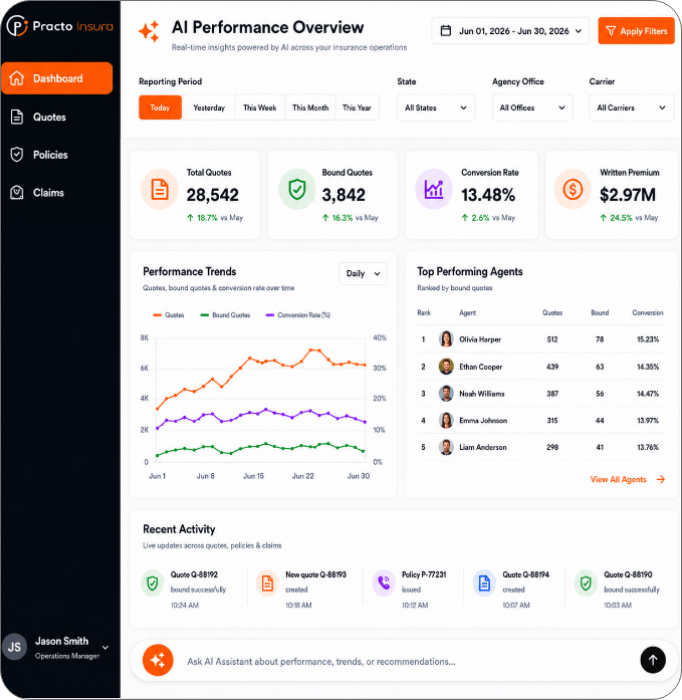
Put AI to Work Across Insurance Operations
Bring AI into everyday P&C workflows to reduce manual effort, simplify access to information, and support faster insurance operations.
-
AI Data Analytics
Generate custom reports and insights from insurance data using natural-language requests.
-

AI Claims Estimator
Estimate claim amounts using vehicle, coverage, and damage information.
-

AI Quote Creation
Capture driver, vehicle, and coverage details through chat or uploaded documents to simplify quote creation.
-

AI Chat & Voice Assistance
Handle routine insurance queries through chat and voice, with escalation to human support when required.
-
AI Document Validation
Extract and validate information from insurance documents to reduce manual review.
What Our Clients Say
Delivering P&C Insurance Carrier Solutions Since 2016
“Practo Insura has streamlined our policy management and helped us deliver better service to our insurers.”

John Crispi
Founder, CoverCube
Practo Insura Insights
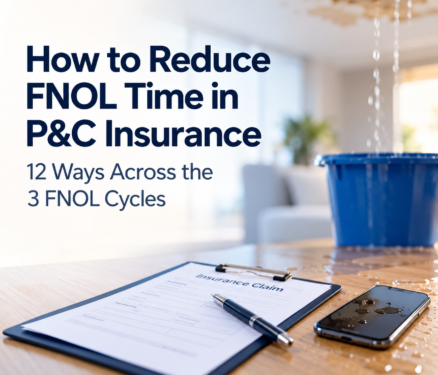
How to Reduce FNOL Time in P&C Insurance: 12 Ways Across the 3 FNOL Cycles
 05 Oct, 2026
A homeowner discovers a burst pipe at 11 p.m. If the loss isn’t reported until the next morning, the insurer has already lost valuable time to initiate mitigation, assess exposure, and begin claim handling. During that gap, damage can continue to develop.
For claims organizations, reducing FNOL time is therefore not simply about improving intake efficiency. Earlier notification gives teams more opportunity to control claim severity, manage loss adjustment expense (LAE), identify potential coverage or recovery issues, and establish communication with the claimant sooner.
The impact of reporting lag is particularly visible in workers’ compensation. According to NCCI’s 2015 analysis, delays in reporting workplace injuries can increase claim costs by up to 51%. Claims reported more than two weeks late also showed greater attorney involvement and lower closure rates at 18 months.
Every FNOL moves through three cycles, and each one adds time. The 12 approaches in this guide address those cycles separately, from foundational practices to emerging capabilities.
Where FNOL Time Is Lost: The Three Operational Cycles
FNOL is often treated as a single intake event. A better way to look at it is as three consecutive time spans within the same claim. Each can add delay before the claims team is ready to act.
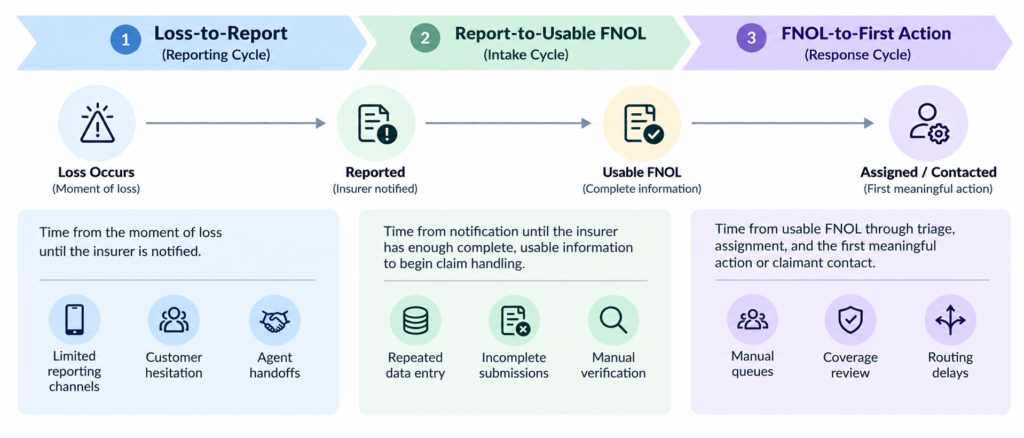
Cycle 1: Loss-to-Report
The reporting cycle begins at the moment of loss and ends when the insurer is notified. Delays can occur because of limited reporting channels, customer hesitation, agent handoffs, or a loss that happens outside normal business hours.
Cycle 2: Report-to-Usable FNOL
The intake cycle runs from notification until the insurer has enough complete, usable information to begin claim handling. Time is often lost through repeated data entry, incomplete submissions, unnecessary questions, document collection, or manual verification.
Cycle 3: FNOL-to-First Action
The response cycle begins once FNOL has been captured and continues through triage, assignment, and the first action or claimant contact. Manual queues, coverage review, routing decisions, and vendor coordination can extend this stage even when the initial report was submitted quickly.
Workers’ compensation data shows why these time gaps matter. An Integrated Benefits Institute analysis of 2.25 million workers’ compensation claims from 2010–2017 found that each additional day between injury and reporting was associated with about $50 more in total payments for medical-only claims. For indemnity claims, each additional day of reporting lag was associated with about $98 more in total payments.
We often see FNOL improvement efforts concentrate on intake because it’s the most visible stage. But delays can build before the claim reaches the insurer and again after the information has been captured.
12 Ways to Reduce FNOL Time Across the Three Claims Cycles
The following approaches address different sources of delay across reporting, intake, and response. Some are established capabilities, while others depend on newer data, automation, and AI-driven workflows.
Cycle 1: The Reporting Cycle
The reporting cycle is the first opportunity to reduce FNOL time because no downstream claims activity can begin until the loss reaches the insurer. According to J.D. Power’s 2026 U.S. Property Claims Satisfaction Study, only 38% of homeowners insurance customers reported FNOL digitally, showing that a large share of property claims still enter through channels that may involve more friction or manual handling.
The goal in this cycle is straightforward: make reporting available at the moment a loss occurs and reduce the number of handoffs between the policyholder, agent, partner, and claims system.
1: 24/7 Omnichannel Reporting
What it does
24/7 omnichannel reporting lets policyholders report a loss through web, mobile, SMS, phone, or chat without waiting for business hours or moving between disconnected channels.
Why it reduces FNOL time
It removes a basic source of delay: access. A claimant who can start FNOL immediately is less likely to wait for an agent or contact center to become available. According to J.D. Power’s 2025 U.S. Auto Claims Satisfaction Study, 26% of auto customers had deductibles of $1,000 or more, while 7% had avoided filing a claim because of concerns about a rate increase. Easier reporting won’t remove that hesitation, but it can reduce friction once a customer decides to file.
How to put it in place
Connect every reporting channel to the same claims workflow and data rules so each submission creates one consistent claim record.
Example
A restaurant owner discovers a break-in early Sunday morning. Rather than waiting for a commercial lines contact to reopen on Monday, the insured can report the loss digitally, provide the basic details, and receive a claim number immediately.
2: Partner and Agent FNOL by API
What it does
Partner and agent FNOL by API allows brokers, agents, body shops, mitigation providers, and other approved partners to submit loss information directly into the claims environment instead of sending details by email or calling a claims team.
Why it reduces FNOL time
The main benefit is fewer handoffs. When a partner already has the loss details, requiring them to pass that information to a separate intake team creates avoidable delay and increases the chance of incomplete or duplicated data. Direct submission moves the claim into the FNOL process as soon as the partner captures the required information.
How to put it in place
Define a minimum data set for each partner type, then connect partner portals or systems to the claims platform through secure APIs. Validation rules should check required fields, policy references, duplicate claims, and submission permissions before the record enters the claims workflow.
Example
After a commercial property water loss, an approved mitigation vendor can submit the initial loss details, property information, and emergency service request directly from its system. The claim enters triage without waiting for a separate email to be reviewed and manually re-entered.
3: Event-Driven FNOL
What it does
Event-driven FNOL uses connected data sources such as vehicle telematics and smart-home sensors to detect a potential loss and automatically trigger, prefill, or prompt the reporting process.
Why it reduces FNOL time
This approach shortens the reporting cycle by reducing dependence on the policyholder to initiate contact. A crash signal, water-leak alert, freeze warning, or fire-related sensor event can create an immediate notification path, giving the insurer an earlier opportunity to confirm the loss and begin the appropriate claims workflow.
How to put it in place
Insurers need reliable event data, policy matching logic, consent controls, and rules that determine when an event should create a claim, open a draft FNOL, or simply prompt the insured to respond. Thresholds should be calibrated carefully so routine events don’t generate unnecessary claims activity.
Example
A connected vehicle detects a significant collision and transmits an event signal within seconds. The system can match the vehicle to the policy, pre-populate available information, and prompt the driver to confirm the loss rather than relying on a later phone call to start FNOL.
Watch out for
This technology is already in production at some large US carriers, but adoption across the broader P&C market remains early.
4: Proactive Catastrophe Outreach
What it does
Proactive catastrophe outreach uses storm-path, hail, wind, and other event data to identify policyholders who may have been affected and contact them before they initiate a claim.
Why it reduces FNOL time
During catastrophe events, reporting delays often increase because contact centers become overloaded and policyholders may not know what information they need to provide. Targeted outreach can shorten that gap by prompting likely affected customers to confirm damage through a digital FNOL path rather than waiting for them to find the correct reporting channel.
How to put it in place
Insurers need reliable catastrophe data, geocoded policy information, and rules for determining which policyholders should receive outreach. Messages should direct customers to a simple reporting flow and make it clear that outreach identifies possible exposure rather than assuming a covered loss has occurred.
Example
After a severe hailstorm crosses a defined area, homeowners with insured properties in the affected zone receive a message asking whether they sustained damage. Customers who confirm a loss can begin FNOL immediately through a prefilled digital flow.
Cycle 2: The Intake Cycle
Once a loss reaches the insurer, the next task is turning the report into information claims teams can use. The aim isn’t to collect everything immediately. It’s to capture the right information at the right point so the claim can move forward without unnecessary intake work.
5: Prefill from Policy Data
What it does
Policy-data prefill automatically brings existing insured, policy, vehicle, property, and coverage information into the FNOL process rather than asking the claimant or adjuster to enter it again.
Why it reduces FNOL time
Re-entering information the insurer already holds adds time without improving the claim record. Prefill allows the claimant to confirm or correct existing details and spend more time providing information that is specific to the loss.
How to put it in place
Connect the FNOL workflow with the policy administration system and define which fields can be safely pre-populated, while keeping a clear way to update information that has changed.
Example
A driver reporting a parking-lot collision opens FNOL and finds the policy number, insured details, covered vehicle, and contact information already populated. The driver confirms those details and moves directly to describing the accident and damage.
6: Dynamic, Loss-Specific Questionnaires
What it does
Dynamic questionnaires change the FNOL questions based on the type of loss and the answers already provided. A windshield claim, theft loss, workplace injury, and multi-vehicle accident shouldn’t follow the same intake path.
Why it reduces FNOL time
Static forms often collect information that has little relevance to the loss while failing to ask the questions claims teams actually need. Branching logic removes unnecessary fields and surfaces follow-up questions only when a previous answer makes them relevant.
How to put it in place
Start with the minimum information required across all claims, then build question sets by line of business and loss type. Claims teams should help define the branching rules so the questionnaire reflects actual triage and assignment needs rather than becoming a longer digital form.
Example
For a workers’ compensation claim involving a lifting injury, the intake can ask about the employee’s role, injury location, treatment received, and work status. It doesn’t need to display questions designed for auto damage, third-party vehicles, or property repairs.
7: Minimum Viable FNOL
What it does
Minimum viable FNOL captures only the information required to establish the claim and move it into triage. Photos, police reports, repair estimates, witness statements, and other supporting material can follow after the claim is opened.
Why it reduces FNOL time
In our experience, intake processes are often treated as if the claim record must be complete before anyone can act. That creates delay inside the intake itself. For many losses, teams need only enough information to identify the policy, understand what happened, locate the loss, contact the claimant, and make an initial routing decision.
The remaining information can be gathered through later digital requests, adjuster follow-up, partner integrations, or third-party data. This separates claim creation from claim enrichment and allows triage and assignment to begin sooner.
How to put it in place
Define the minimum data needed to open and route a claim by line of business, then identify what can safely be collected later. Complex injury, fraud, or coverage-sensitive claims should still trigger additional upfront requirements.
Example
After a fleet vehicle accident, the insured may not yet have complete driver statements, repair estimates, or third-party documentation. The claim can still be opened with the policy, vehicle, driver, date and location of loss, known damage, and contact details while the remaining information is collected later.
Watch out for
A faster intake still needs enough information for basic fraud screening and an initial reserve; minimum viable FNOL should remove unnecessary upfront work, not essential controls.
8: Generative AI Voice Agents for FNOL
What it does
AI voice and chat support agents can handle natural phone conversations for straightforward FNOL interactions, especially after hours. For more complex calls, they can transcribe the conversation and structure key claim details for a human reviewer.
Why it reduces FNOL time
Conversational voice AI can collect initial loss information as the call happens instead of placing the claimant in a queue or requiring a callback. Unlike older IVR or scripted chatbot flows, newer systems can interpret more natural descriptions and ask follow-up questions based on the conversation.
How to put it in place
Start with well-defined, lower-complexity claim types and clear escalation rules. The system should write structured data into the FNOL workflow, preserve the call record, and transfer the claimant to a person when injury, distress, coverage uncertainty, or unusual circumstances require judgment.
Example
A homeowner calling after hours about a minor kitchen fire can describe what happened conversationally. The voice agent captures the loss location, reported damage, emergency response, and contact details, then prepares the claim for review.
Cycle 3: The Response Cycle
Once the FNOL is usable, speed depends on how quickly the claim moves into triage, assignment, and action. McKinsey has identified the potential for claims transformation to reduce loss adjustment expenses by 25–30% and indemnity spend by 3–5 percentage points. That’s a reminder of what’s at stake when early claims work still depends heavily on manual steps.
The focus here is to remove avoidable queues between intake and the first claims decision, contact, or service action.
9: Instant Acknowledgment and Proactive Status Updates
What it does
Instant acknowledgment confirms that the claim has been received, provides a claim number and next steps, and keeps the claimant informed as the claim progresses.
Why it reduces FNOL time
Acknowledgment doesn’t shorten the reporting event itself, but it reduces the gap between submission and the claimant’s first confirmation that the process has started. Proactive updates also reduce inbound status calls that can consume adjuster capacity during early claim handling.
J.D. Power’s 2026 U.S. Property Claims Satisfaction Study found that 45% of customers received claim updates digitally, indicating that digital communication is already an important part of the claims experience.
How to put it in place
Trigger acknowledgments directly from claim creation and connect later updates to real workflow events such as assignment, document requests, inspections, or vendor appointments. Because prompt-acknowledgment requirements vary by state, automated communication should support jurisdiction-specific compliance controls.
Example
An employer reports a warehouse injury online and immediately receives a claim number, next steps for submitting the medical provider’s details, and confirmation when a claims professional is assigned.
10: AI Triage at FNOL with Automated Routing
What it does
AI-assisted triage evaluates the information available at FNOL to identify factors such as severity, fraud risk, litigation potential, and subrogation opportunity, then routes the claim to the appropriate handling path.
Why it reduces FNOL time
Without automated routing, claims may sit in a general assignment queue while someone reviews the file and decides where it belongs. Triage logic can move straightforward claims toward fast-track or straight-through processing (STP) while directing higher-risk cases to experienced adjusters earlier.
How to put it in place
Start with clearly defined routing rules and use AI to support, not obscure, those decisions. Models should rely on explainable inputs, integrate with claims management workflows, and allow claims teams to override routing when new information changes the exposure.
Example
A low-severity glass claim with clear coverage and no injury indicators can move directly into a fast-track workflow, while a multi-vehicle accident with bodily injury indicators is routed immediately to a senior adjuster.
Watch out for
Poor data quality or weak model governance can create faster routing without better routing, so outputs need ongoing review against actual claim outcomes.
11: Automatic Vendor Dispatch
What it does
Automatic vendor dispatch connects the FNOL process directly with approved service providers so towing, glass repair, rental, or emergency mitigation can be initiated without waiting for a separate manual handoff.
Why it reduces FNOL time
The delay often comes after the claim is opened but before the first service action occurs. If an adjuster or contact-center employee has to review the file, identify a vendor, and send instructions manually, hours can be lost before assistance reaches the claimant.
How to put it in place
Define which loss types qualify for automatic dispatch, maintain approved vendor networks, and connect vendor availability and assignment data to the claims workflow. Claims teams should still be able to intervene when the loss is complex or the policyholder needs a different service option.
Example
After an auto collision leaves a vehicle undrivable, the FNOL workflow can dispatch an approved towing provider and initiate a rental referral as soon as the required claim checks are completed. The insured doesn’t have to wait for a separate adjuster handoff before those services begin.
12: AI-Assisted Coverage Checks at FNOL
What it does
Basic policy verification already confirms items such as whether the policy is active and whether the relevant coverage type exists. The emerging step is using AI to review policy wording, endorsements, deductibles, and authority limits to flag possible coverage issues during FNOL.
Why it reduces FNOL time
Coverage questions can delay assignment or early action when an adjuster has to search across policy documents before deciding how the claim should proceed. AI-assisted review can surface relevant provisions and potential conflicts earlier so the file reaches the right person with more context.
How to put it in place
Connect the claims workflow to authoritative policy documents and define which coverage questions AI can flag for review. Outputs should show the source wording behind each flag and route uncertain or complex cases to qualified claims staff rather than making autonomous coverage decisions.
Example
A commercial property loss is reported for damage involving a scheduled location and recent endorsement changes. The system surfaces the relevant endorsement language and deductible information for the adjuster before the first coverage review.
Watch out for
AI-driven coverage analysis still requires human review, clear authority controls, and careful governance.
Where MGAs Can Reduce FNOL Friction
MGAs with delegated claims authority often manage FNOL under carrier oversight while working with leaner teams, multiple carrier requirements, and bordereaux reporting obligations. That makes consistency at intake especially important.
Three approaches in this guide are particularly relevant. Partner and agent FNOL by API can reduce handoffs when brokers or distribution partners already hold the loss details. Generative AI voice agents can extend after-hours reporting capacity without requiring a full overnight intake team. AI-assisted coverage checks can also help surface carrier-specific policy wording, endorsements, and authority limits earlier in the process.
For MGAs, the biggest gains often come from capturing clean, consistent FNOL data up front, which reduces rework later in carrier reporting and bordereaux.
KPIs to Track Across the Three FNOL Cycles
Tracking FNOL performance by cycle makes it easier to identify where delay is actually occurring rather than relying on one end-to-end average.
| Cycle | KPI | What It Tells You |
|---|---|---|
| Reporting | Loss-to-report lag | How quickly losses reach the insurer |
| Reporting | % of claims reported digitally or by partners | Adoption of faster reporting channels |
| Intake | Average time to complete intake | How efficiently usable claim information is captured |
| Intake | Digital FNOL abandonment rate | How often claimants leave digital FNOL before completing it; track by step to see where |
| Response | FNOL-to-assignment time | How quickly claims move through triage and routing |
| Response | FNOL-to-first-contact time | How quickly the claimant hears from a person or receives a first service action, not just an automated acknowledgment |
These KPIs should also be segmented by line of business and loss type. Portfolio-wide averages can hide delays that affect specific claim categories, channels, or operating teams.
Faster FNOL Requires More Than Faster Intake
Reducing FNOL time means improving all three cycles, reporting, intake, and response not just the intake form.
The strongest FNOL programs remove avoidable waiting without sacrificing controls, data quality, or human judgment where it matters. That usually means fixing foundational gaps first, then applying automation and AI where they solve a specific operational delay.
Not sure where your gaps are? Book a free FNOL assessment with Practo Insura.

Top 9 Claims Estimator Solutions for P&C Insurance in USA
23 Sep, 2026
Claims estimating can involve significant manual work, from reviewing damage photos and identifying repair needs to checking costs and preparing an estimate. As claim volumes grow, these steps can slow the process and increase pressure on claims teams.
Claims estimator technology helps automate parts of this work by analyzing claim data, images and pricing information to support damage assessment, repair scoping and estimate creation.
For P&C insurers, the market now includes established platforms such as CCC, Xactimate and Mitchell, as well as newer AI tools that support photo-based assessments, remote inspections and integration with existing claims systems.
Not all of these solutions work in the same way. Some generate detailed estimates, while others provide damage assessments or initial scopes for adjuster review.
In this guide, we compare nine claims estimator solutions across auto and property insurance, including their capabilities, integrations and level of human involvement.
Quick Comparison of Claims Estimator Solutions
The solutions below differ in the claims they support, how they are deployed and how much of the estimating process they handle.
| Solution | Claims Type | Main Capability | Deployment | Human Involvement |
|---|---|---|---|---|
| CCC Intelligent Solutions | Auto | AI-assisted line-item estimating and straight-through estimating for eligible claims | CCC platform | Smart Estimate supports appraiser review; Estimate-STP can automate eligible claims |
| Practo Insura | Auto & Property | AI-assisted damage assessment and estimated claim information | Platform / Integration | Adjuster reviews and can revise estimates |
| Mitchell / Enlyte | Auto | AI-assisted component identification and line-item estimating | Cloud estimating platform | Appraisers can review, complete and approve estimates |
| Tractable | Auto & Property | Computer vision damage assessment and estimate support | API / Web integration layer | Depends on carrier workflow and level of automation |
| Ravin AI | Auto | Remote vehicle inspection, damage assessment and repair-cost calculation | API / Mobile / Web | Depends on insurer workflow |
| Hosta AI | Property | Remote interior assessment, measurements, scoping and estimating support | API / Assessment platform | Depends on how outputs are used within the estimating workflow |
| Verisk Xactimate | Property | Line-item property estimating with localized pricing and AI assistance | Desktop / Online / Mobile | Users can review, edit or override AI recommendations |
| Cotality Claims Estimate | Property | Property estimating, LiDAR scoping and AI-assisted voice-to-line-item input | Desktop / Mobile | Adjuster-led with AI and automated validation support |
| Solera Qapter / Audatex | Auto | AI-assisted damage detection, line-item estimating and total-loss support | Modular cloud platform | Supports automated workflows with appraiser review where required |
3 Platform-Native Claims Estimating Solutions
These solutions provide estimating as part of a broader claims platform, allowing insurers to connect damage assessment, estimate creation and other claims activities within the same environment.
1. CCC Intelligent Solutions
CCC Intelligent Solutions is widely used across the U.S. auto claims ecosystem, connecting insurers with repair facilities, parts suppliers and other participants involved in the claims process.
For estimating, CCC offers Smart Estimate and Estimate-STP, which support different levels of automation. Smart Estimate applies CCC’s estimating logic and AI to collision photos to identify likely repair requirements and recommend estimate lines. It is designed to guide appraisers through the estimating process, while insurers can configure estimating parameters and business rules around their own requirements.
Estimate-STP extends automation further by allowing eligible claims to move through a straight-through estimating workflow. Carriers can define rules and eligibility thresholds that determine which claims can be handled automatically and which require adjuster review.
Because these capabilities operate within CCC’s broader auto claims environment, estimating can connect with other activities such as repair facility assignment, parts sourcing and total-loss handling.
Key Strengths
- Strong presence across the U.S. auto claims ecosystem
- Supports both AI-assisted and straight-through estimating workflows
- Allows insurers to configure business rules and claim eligibility criteria
- Connects estimating with other auto claims processes
Considerations
- Focused primarily on auto physical damage
- Smart Estimate supports appraisers rather than operating as a fully touchless estimating process
- Straight-through processing depends on carrier-defined rules and claim eligibility
Claims supported: Auto physical damage
Input: Collision photos, VIN and claim data
Output: Repair requirements and line-level estimate recommendations
Deployment: CCC platform
Human involvement: Smart Estimate supports appraiser review, while eligible claims can use Estimate-STP for straight-through processing
Best suited for: U.S. auto insurers looking to combine AI-assisted estimating with configurable automation within a broader claims ecosystem
2. Practo Insura
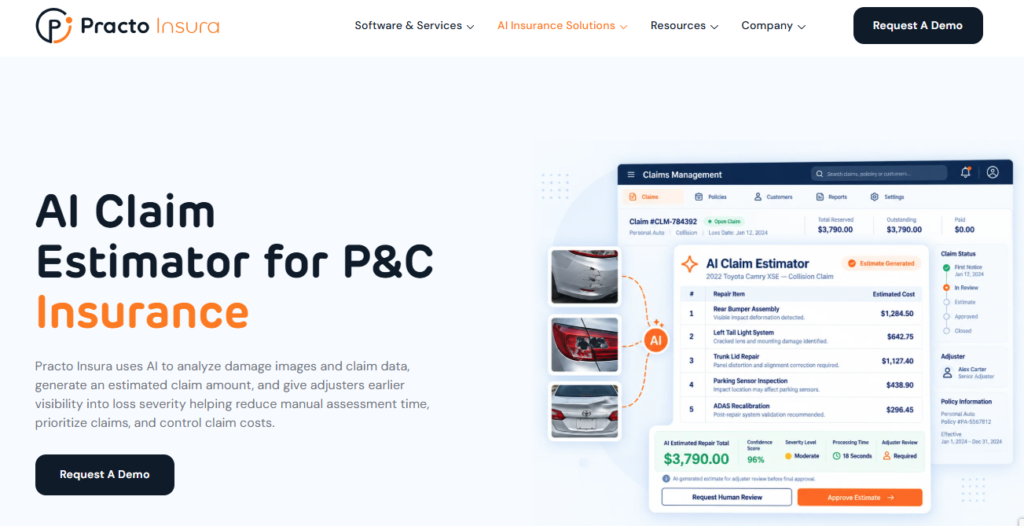
Practo Insura provides AI-assisted claims estimation for P&C insurers across both auto and property claims, giving carriers more flexibility than solutions focused on a single line of business. It can be used within Practo Insura’s claims platform or integrated into an insurer’s existing core environment, making it suitable for carriers that want to add AI without necessarily replacing their current claims system.
The estimator analyzes damage images and claim data to identify affected components, reference repair or replacement costs, and generate an estimated claim amount with an AI-generated damage summary. Rather than treating the estimate as a final automated decision, the system gives adjusters a structured starting point that they can review and refine.
Adjusters can revise estimates before the claim progresses, while estimate versioning keeps a record of previous and updated amounts, dates and user changes. This helps combine faster AI-assisted estimation with the control and traceability claims teams still need.
Key Strengths
- Supports both auto and property claims
- Can work within Practo Insura Claims or alongside an existing core system
- Keeps adjusters in control of final estimate review
- Supports estimate version history and auditability
- Can be configured around carrier-specific claims workflows rather than forcing a fixed process
Considerations
- Implementation is tailored to insurer requirements rather than provided as a fixed off-the-shelf package
- Integration scope depends on the carrier’s existing systems and workflow requirements
Claims supported: Auto and property
Input: Damage images and claim data
Output: Estimated claim amount and AI-generated damage summary
Deployment: Practo Insura platform or integration with an existing core system
Human involvement: Adjuster reviews and can revise the estimate before the claim moves forward
Best suited for: P&C carriers, MGAs and specialty insurers that want AI-assisted estimation with greater workflow flexibility and adjuster control
3. Enlyte / Mitchell
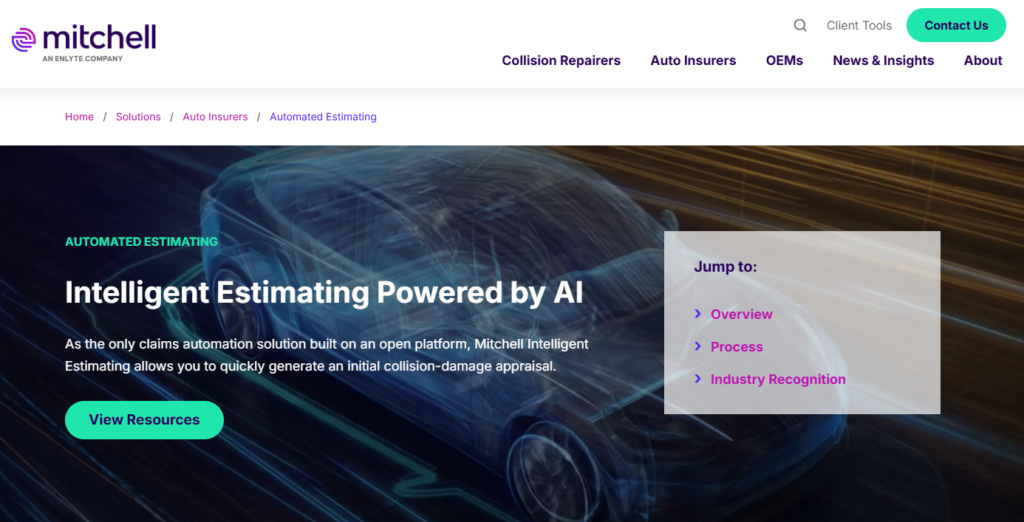
Mitchell, part of Enlyte, provides auto physical damage estimating technology for insurers and repair organizations. Its broader estimating environment includes Mitchell Cloud Estimating, while its AI-assisted estimating capability is branded Mitchell Intelligent Estimating.
At the core of the AI workflow is Mitchell Intelligent Damage Analysis, which uses computer vision to evaluate vehicle damage images, identify affected components and recommend repair operations. These recommendations can then be mapped to individual estimate lines and incorporated into the estimating process.
One of Mitchell’s strongest differentiators is its open architecture. Carriers can use Mitchell’s own AI capabilities or connect third-party computer vision providers, giving insurers more flexibility in how they build their estimating workflow. Estimate data can also be exchanged using CIECA BMS standards, helping support interoperability with other claims systems.
Key Strengths
- Strong focus on auto physical damage estimating
- AI recommendations can support line-item estimate creation
- Open architecture allows third-party AI integration
- Supports CIECA BMS data exchange
- Gives carriers flexibility in how AI is incorporated into their estimating workflow
Considerations
- Primarily focused on auto rather than property claims
- Workflow complexity may increase when multiple third-party AI tools are integrated
- The final level of automation depends on carrier configuration and connected technologies
Claims supported: Auto physical damage
Input: Vehicle damage photos and claim information
Output: Component-level repair recommendations and estimate lines
Deployment: Cloud-based estimating platform
Human involvement: Appraisers can review, complete and approve AI-assisted estimates
Best suited for: Auto insurers that want an established estimating platform with flexibility to integrate their preferred AI technologies
3 Standalone AI Claims Assessment Solutions
These tools focus on AI-driven damage analysis, remote inspection or image-based assessment and typically feed their outputs into an insurer’s existing claims or estimating system.
4. Tractable
Tractable uses computer vision to analyze damage images across both auto and property claims. Rather than functioning only as a standalone estimating platform, it is designed to work as an AI layer that can support and enhance an insurer’s existing claims and estimating environment.
Its technology can support several stages of the claims process, including FNOL triage, damage assessment, estimate pre-population, and estimate review. For auto claims, Tractable can analyze collision photos and help generate a partial or complete estimate that can flow into an established estimating workflow.
On the property side, policyholders can submit damage photos through a web-based experience. Tractable’s AI can identify, classify and measure damage, with the resulting information used to support estimate generation within systems such as Xactimate.
A major strength is its integration model. Tractable works with established platforms including Mitchell for auto and Verisk Xactimate for property, allowing insurers to introduce AI-driven image analysis without replacing their existing estimating systems.
Key Strengths
- Supports both auto and property claims
- Strong focus on computer vision and image-based damage assessment
- Can support estimate pre-population and review
- Integrates with established estimating platforms such as Mitchell and Xactimate
- Allows insurers to add AI capabilities without replacing their current estimating environment
Considerations
- Often works alongside another estimating platform rather than replacing it
- Final estimating workflow depends on the carrier’s existing systems and integrations
- Level of automation varies depending on implementation and claim type
Claims supported: Auto and property
Input: Damage photos submitted by policyholders, repair facilities or adjusters
Output: Damage assessment, estimate inputs, repair recommendations and review support
Deployment: API and web-based integration layer
Human involvement: Depends on carrier workflow and level of automation
Best suited for: Insurers that want to add AI-powered image analysis and estimation support while retaining their existing estimating platforms
5. Ravin AI
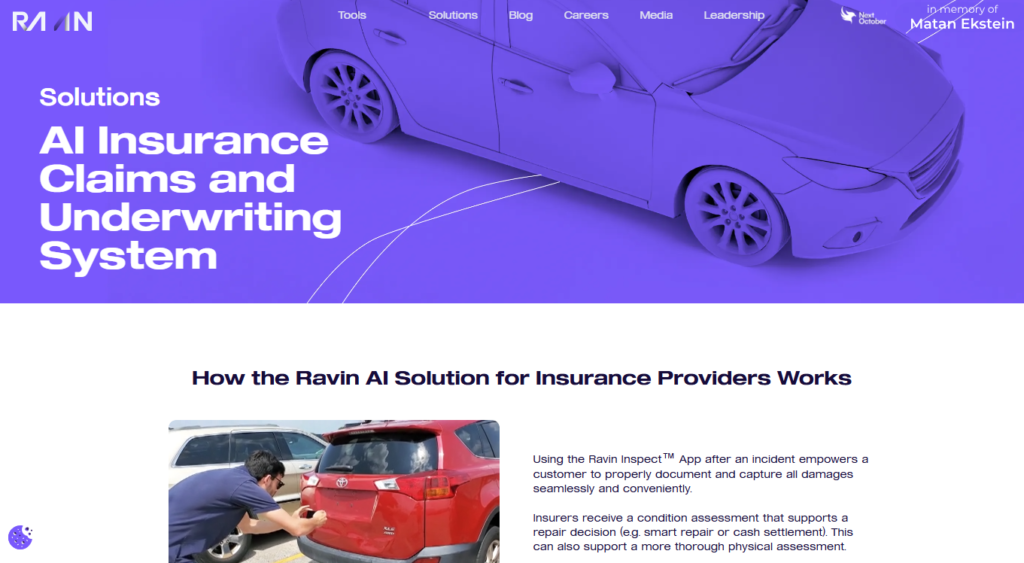
Ravin AI focuses on vehicle inspection and damage assessment for auto claims, using computer vision to analyze photos and video captured from claimants, tow operators or other users in the field.
Its workflow starts with guided image capture. RAVIN Inspect allows users to submit vehicle photos or video from a mobile device without installing a dedicated app, while RAVIN Eye supports damage review, repair-versus-total-loss triage and repair cost calculation.
The results can then be passed into the insurer’s existing claims environment through APIs. This makes Ravin particularly relevant for carriers that want to improve remote vehicle inspection and early claims triage without replacing their broader claims management system.
Key Strengths
- Combines guided vehicle capture with AI-based damage assessment
- Supports photo and video submission without requiring a dedicated app
- Can support repair cost calculation and total-loss triage
- API-based architecture supports integration with existing claims systems
- Useful for remote inspection and early-stage claims handling
Considerations
- Focused on auto claims rather than property
- Estimating is closely linked to vehicle inspection and capture workflows
- Final use of the AI output depends on the insurer’s claims process and integration setup
Claims supported: Auto
Input: Guided mobile photos and video
Output: Damage assessment, repair cost calculation, triage and total-loss recommendation
Deployment: API with mobile/web capture tools
Human involvement: Depends on the insurer’s claims workflow
Best suited for: Auto insurers and mobility businesses looking to combine remote vehicle inspection with AI-supported claims assessment
6. Hosta AI
Hosta AI focuses on property claims, particularly interior damage assessment and remote property documentation. Policyholders or field users can capture a small set of room images, which Hosta analyzes to generate measurements, material details, damage information and structured property data.
The platform can produce floor plans, 3D measurements, elevations and Xactimate Sketch output. Hosta has also positioned its technology as capable of supporting completed estimates, rather than only providing preliminary scoping information.
This makes Hosta useful for insurers looking to reduce reliance on physical interior inspections while still feeding structured data into established estimating workflows. Its integrations are not limited to Xactimate alone, with support also extending into other claims and estimating environments.
Key Strengths
- Built specifically for interior property claims
- Can reduce the need for on-site property inspections
- Generates measurements, floor plans, elevations and 3D property data
- Supports Xactimate Sketch generation
- Can contribute to completed estimating workflows, not only preliminary scoping
- Designed to integrate with established claims and estimating systems
Considerations
- Focused primarily on property rather than auto claims
- The final workflow depends on the estimating platform and carrier implementation
- Insurers should evaluate how Hosta’s generated estimate or assessment data fits into their existing review process
Claims supported: Property
Input: Interior property photos
Output: Damage assessment, measurements, floor plans, elevations, 3D data, Xactimate Sketch and estimating information
Deployment: API / assessment platform
Human involvement: Depends on how the insurer incorporates Hosta output into its estimating and review workflow
Best suited for: Property insurers looking to automate interior assessment, reduce site visits and feed structured property data into established estimating systems
3 Established Claims Estimating Systems
These are mature estimating platforms built around repair, construction or pricing data, with newer AI and automation capabilities being added to support existing estimating workflows.
7. Verisk Xactimate
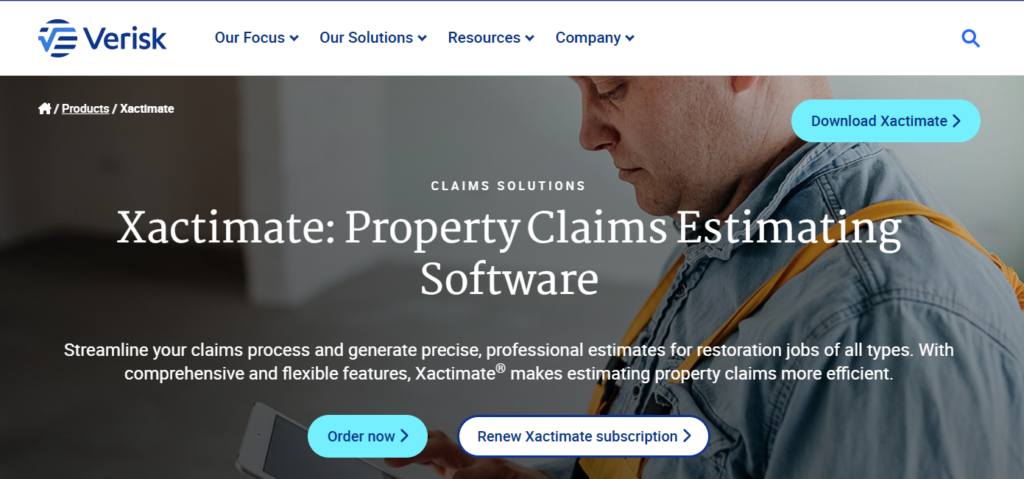
Verisk Xactimate is one of the most established property claims estimating platforms in the U.S. and Canada. It is built around localized pricing data for materials, labor and repair activities, helping adjusters create detailed line-item estimates based on the scope and location of a loss.
The platform works across desktop, online and mobile environments and connects with XactAnalysis for assignment, estimate exchange and broader claims workflow management. Verisk researches pricing across more than 460 localized markets in the U.S. and Canada, giving estimators location-specific cost information when building property estimates.
Verisk has also expanded its AI capabilities through XactAI. These features can support line-item recommendations, automatic photo labeling and descriptions, note summarization and floor plan capture through Sketch Scan. AI-generated output is still designed to support human decision-making, with users able to review, edit or override recommendations.
Key Strengths
- Established property claims estimating ecosystem
- Detailed line-item estimates supported by localized pricing data
- Pricing research across more than 460 U.S. and Canadian markets
- AI can support line-item recommendations, documentation and floor plan capture
- Broad integration ecosystem through XactAnalysis and third-party technologies
- Human review remains part of the estimating process
Considerations
- Focused mainly on property rather than auto claims
- Works best within the wider Xactimate and XactAnalysis ecosystem
- AI capabilities assist the estimating process rather than replacing adjuster judgment
Claims supported: Property
Input: Adjuster scope, photos, sketches, floor plan data and other property information
Output: Detailed line-item property estimate
Deployment: Desktop, online and mobile
Human involvement: Users can review, edit or override AI-generated recommendations
Best suited for: Property insurers, adjusting firms and restoration organizations that need detailed estimating supported by localized pricing data and an established claims ecosystem
8. Cotality Claims Estimate

Cotality Claims Estimate, formerly known as Symbility Mobile Claims under CoreLogic, is a property estimating platform built for both field and desk-based claims workflows. It combines structured estimating tools with construction pricing data to help claims teams create detailed property repair estimates.
The platform supports guided estimating, photo capture, diagramming and LiDAR-based room scanning on supported iOS devices. Cotality also promotes an AI-powered voice engine that can convert spoken descriptions of property damage into estimate line items, helping adjusters capture information more quickly while working in the field.
Claims Estimate sits within Cotality’s broader property claims environment, alongside tools for inspection, scoping, workflow management and estimate validation. This allows insurers to connect estimating with other parts of the property claims process rather than treating it as a separate activity.
Key Strengths
- Built specifically for property claims estimating
- Supports both desktop and mobile workflows
- Includes LiDAR-based room scanning for field scoping
- AI-powered voice input can help convert spoken damage descriptions into line items
- Uses construction pricing data to support detailed estimates
- Connects with a broader suite of property claims tools
Considerations
- Focused on property rather than auto claims
- The estimating workflow remains adjuster-led even with newer AI assistance
- Insurers should evaluate how the broader Cotality claims suite fits with their existing systems
Claims supported: Property
Input: Adjuster scope, photos, diagrams, LiDAR scans and voice input
Output: Detailed line-item property estimate
Deployment: Desktop and mobile
Human involvement: Adjuster-led, with AI and automated validation supporting the estimating process
Best suited for: Property insurers and adjusting firms looking for mobile-first estimating, field scoping tools and AI-assisted workflow support
9. Solera Qapter / Audatex
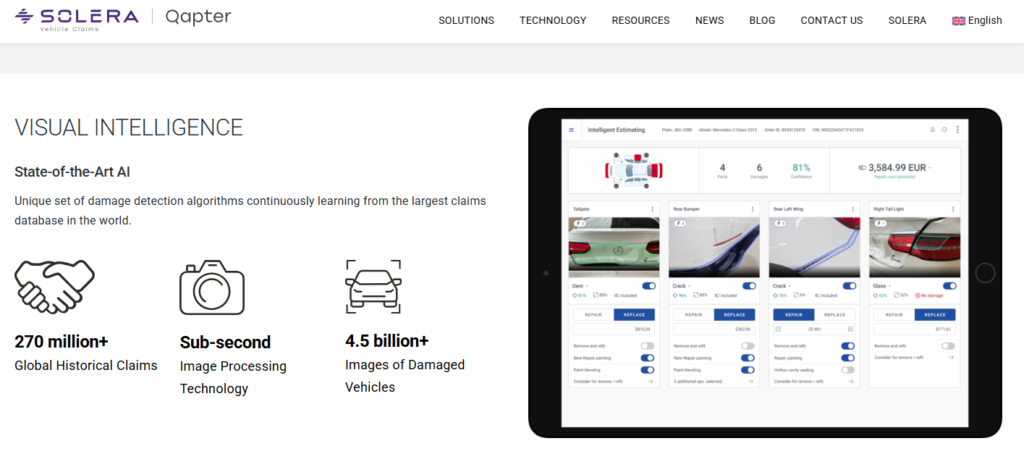
Solera Qapter is an AI-assisted auto claims estimating solution designed to support the process from damage capture through estimating and settlement. It uses image analysis to identify damaged vehicle parts, assess damage severity and recommend repair operations that can be translated into line-item estimates.
The platform combines AI with Solera’s vehicle and repair data to support repair planning, estimating, triage and total-loss workflows. Solera positions the AI as a tool that complements human expertise, allowing appraisers or claims teams to review and adjust estimates when required.
Qapter is offered as a modular cloud-based suite, so insurers can use individual capabilities or combine them into a broader auto claims workflow. Solera has also expanded the platform with Qapter Direct Dispatch, which adds AI-assisted damage estimating and automated vehicle equipment identification to help move claims more efficiently from intake into the estimating process.
Key Strengths
- Strong focus on auto physical damage estimating
- Uses AI for damage detection, parts identification and repair recommendations
- Supports line-item estimates, triage and total-loss workflows
- Modular architecture allows insurers to select specific capabilities
- Qapter Direct Dispatch adds AI-assisted estimating earlier in the claims process
- Supports workflows where human appraisers can review and adjust AI-generated estimates
Considerations
- Focused on auto rather than property claims
- The level of automation depends on the modules and workflow used
- Human review may still be required depending on carrier requirements
Claims supported: Auto physical damage
Input: Vehicle damage photos, VIN and claim data
Output: Damage assessment, repair operations, line-item estimate and total-loss support
Deployment: Modular cloud platform
Human involvement: AI can support automated workflows, with appraiser review available where required
Best suited for: Auto insurers looking for AI-assisted estimating within a modular claims workflow that can support both automation and human review
How Claims Estimation Solutions Differ
Claims estimator solutions do not all play the same role in the claims process. Some are built directly into broader claims platforms, others work as AI layers that support an existing estimating system, and some are long-established estimating tools that are gradually adding more automation.
Platform-Native Estimating
Solutions such as CCC, Practo Insura and Mitchell place estimating within a broader claims environment. This can help insurers connect damage assessment and estimate creation with other workflows such as claim handling, repair management, total-loss processing or adjuster review.
Standalone AI Assessment
Tools such as Tractable, Ravin AI and Hosta AI focus more heavily on image analysis, remote inspection and damage assessment. They are often used alongside an insurer’s existing claims or estimating platform rather than replacing it completely.
Established Estimating Systems
Platforms such as Verisk Xactimate, Cotality Claims Estimate and Solera Qapter are built around established estimating workflows, pricing data and repair or construction information. AI and automation are increasingly being added to these systems to support faster scoping, line-item recommendations and more efficient estimate preparation.
For insurers, the main question is therefore not only which vendor offers the most features, but which type of estimating model fits the existing claims environment, line of business and desired level of automation.
Conclusion
Claims estimation technology now covers a wide range of approaches, from established estimating platforms to AI-driven assessment tools and more configurable claims systems.
For insurers, the right choice depends on more than the amount of AI a platform uses. The more important questions are whether the solution supports the right line of business, fits the existing claims environment, produces the type of estimate or assessment required, and gives claims teams the appropriate level of human oversight.
Auto carriers may prioritize vehicle damage analysis, repair estimating and total-loss workflows, while property insurers may place more emphasis on scoping, measurements, construction pricing and remote inspections. Some insurers may need a complete estimating platform, while others may be better served by adding an AI layer to systems they already use.
For carriers looking for a more configurable approach across auto and property claims, Practo Insura provides AI-assisted claims estimation that can be built around existing workflows and integrated with the broader claims environment.
7 Signs Your P&C Insurance Company Is Ready for AI Automation
14 Aug, 2026
For U.S. P&C insurers, AI is shifting from a technology experiment to a consideration in day-to-day operations. Carriers and MGAs are evaluating how it can help them handle growing workloads, improve operational efficiency, and make better use of existing resources. But adopting AI is not simply a matter of selecting a solution and putting it into production.
The more important question is whether the organization is ready to use AI effectively.
An insurer may have processes that appear well suited to automation but lack the data, integration capabilities, or operational foundation needed to support it. Another may have the right technology environment but no clearly defined business problem or measurable outcome to justify an AI initiative.
That makes readiness an important part of the decision. Before evaluating solutions, insurance leaders need to understand whether their current processes, teams, technology, and business priorities create a practical foundation for AI automation.
Here are seven signs that your P&C insurance company may be ready to take the next step.
1. Your Teams Are Spending Too Much Time on Repetitive Work
P&C insurance operations involve a steady stream of routine activities, from collecting information and reviewing documents to updating records and moving data between systems. These tasks are necessary, but they don't always require the full attention of experienced insurance professionals.
The issue becomes more significant when routine work starts taking up a substantial share of team capacity. Employees have less time for work that requires judgment and expertise, while growing volumes put additional pressure on the same teams.
Look for signs such as:
- Employees repeatedly performing the same steps across large volumes of work.
- Skilled staff spending significant time gathering, checking, or transferring information.
- Teams adding capacity primarily to keep up with routine operational workload.
AI automation can address parts of this problem by taking on defined, repeatable tasks within an existing workflow. Depending on the process, this could include extracting information from documents, organizing incoming data, or routing information to the appropriate next step. Employees remain responsible for decisions and exceptions that require professional judgment.
When routine work is consuming more employee capacity without adding corresponding business value, it may be one of the clearest areas to evaluate for AI automation.
Related Read: 9 Customer Support Workflows Every P&C Insurer Should Automate
2. Your Operational Workload Is Growing Faster Than Your Team
A P&C insurer can have efficient processes and still run into a capacity problem when business volume grows faster than the team supporting it. More policies, submissions, claims, or service requests can quickly increase the amount of operational work that needs to be handled.
The warning sign is not simply that employees are busy. It's when growth consistently requires additional manual capacity to maintain the same level of service.
The warning signs usually appear when:
- Processing backlogs increase as business volume rises.
- Teams need additional resources primarily to handle higher transaction volumes.
- Service levels become harder to maintain during periods of increased demand.
- Operational capacity becomes a constraint on taking on more business.
AI automation can give insurers another way to scale capacity. Instead of treating every increase in volume as a need for proportional increases in manual effort, carriers and MGAs can identify workflows where AI can handle defined tasks or support employees.
This creates a more scalable operating model: business volume can grow without every increase automatically translating into more manual workload.
3. Manual Handoffs Are Slowing Down Your Workflows
P&C insurance workflows often span multiple teams, applications, and stages. Information may need to move from one person or system to another before a task can progress. When those transitions depend on manual intervention, even a straightforward process can take longer than it should.
The problem isn't simply the number of handoffs. It is the friction created at each transition, waiting for information, checking whether something has been completed, re-entering data, or following up with another team.
This tends to show up when:
- Work frequently waits for another team or system before it can move forward.
- Employees spend time checking, forwarding, or reconciling information.
- The same data is handled multiple times during a single workflow.
- Teams rely on email or spreadsheets to coordinate steps that should happen within a defined process.
AI automation can help reduce this friction by handling specific transitions within a workflow, for example, extracting information, determining where it belongs, triggering the next step, or flagging an item that needs human attention.
The opportunity isn't to remove every handoff. It's to reduce the manual coordination required to keep routine work moving.
4. Your Teams Are Struggling to Keep Up With the Volume of Information
P&C insurers work with information from policy systems, claims files, documents, correspondence, and other operational sources. As that volume grows, teams can spend more time finding, reviewing, and organizing information before they can act on it.
The issue isn't necessarily a lack of data. It is the amount of human effort required to turn that information into something usable.
Common indicators include:
- Employees spend significant time searching across different sources for relevant information.
- Important details are buried in large volumes of documents or records.
- Teams rely heavily on manual review before they can move a process forward.
AI automation can help reduce this workload by handling parts of the information-processing process and bringing relevant information into the workflow at the point it is needed. That can help employees spend less time working through information and more time applying their insurance expertise.
When information volume becomes a capacity problem rather than simply a data asset, it may be time to evaluate how AI can help your teams work with it more efficiently.
5. Your Teams Are Spending Too Much Time on Decisions That Follow a Defined Pattern
Not every insurance decision is straightforward, but many operational decisions involve established criteria, available data, and repeatable steps. When experienced employees spend significant time working through these routine decisions manually, their expertise can become tied up in work that follows a relatively consistent pattern.
For example, you may notice:
- Similar cases require employees to repeatedly review the same types of information.
- Teams rely on manual checks to determine the next step in a workflow.
- Different employees spend time working through the same decision process independently.
- Routine decisions are creating delays for cases that actually require deeper judgment.
AI can assist by evaluating available information against defined criteria and helping employees identify the appropriate next step. This doesn't mean handing decision-making entirely to AI. Instead, it can provide a consistent starting point for routine cases while escalating exceptions or higher-risk situations to the appropriate professional.
When a decision process is structured enough to follow a pattern but still consumes substantial employee time, it may be worth evaluating whether AI can assist with the process.
6. Your Existing Technology Can Support AI Integration
An insurer does not need to replace its core technology to start exploring AI automation. What matters is whether the systems involved in a potential workflow can exchange information and support the connections required to introduce a new capability.
You may be ready to explore AI if:
- Key systems have APIs or other reliable methods for exchanging data.
- The information needed for a workflow is available digitally.
- Your technology team can map how information moves between the systems involved.
- New capabilities can be introduced without disrupting critical operations.
AI is only useful when it can access the information it needs and connect with the next step in the workflow. Otherwise, it risks becoming another disconnected layer of technology.
For P&C insurers, the goal should be to integrate AI into a useful workflow rather than add another standalone tool. If your existing environment can support that kind of controlled integration, you may be able to start with a focused AI initiative without undertaking a broader technology overhaul.
Related Read: How to Build Right Core Technology Stack
7. Leadership Has a Clear Business Outcome in Mind
AI should start with a business problem, not with a decision to “implement AI.” For a P&C insurer, that could mean increasing operational capacity, shortening processing times, reducing manual effort, or improving consistency within a specific workflow.
The important question is whether leadership can define what needs to improve and how the result will be measured.
Before selecting a solution, the organization should be able to answer:
- What problem are we trying to solve?
- Where is the current process falling short?
- What would a measurable improvement look like?
- How will we determine whether the investment is worthwhile?
Having clear answers creates a much stronger foundation for an AI initiative. It gives business and technology teams a shared objective and makes it easier to select an appropriate workflow, establish a baseline, and evaluate results after implementation.
If AI has a defined business purpose and a measurable outcome behind it, your organization is in a much stronger position to move from exploring the technology to evaluating a practical implementation.
What to Do Before Implementing AI Automation
Recognizing the signs is only the starting point. Once an insurer identifies a workflow that may benefit from AI, the next step should be a focused assessment rather than trying to automate multiple processes at once.
1. Start With One Workflow
Choose a process with a clear operational challenge, meaningful volume, and defined steps. Starting with one workflow makes it easier to understand the current process and determine whether AI can improve it.
2. Establish a Baseline
Measure how the process performs today. Depending on the workflow, this could include processing time, manual effort, turnaround time, volume, or exception rates. Without a baseline, it is difficult to determine whether automation has created a meaningful improvement.
3. Assess Data and Integration Requirements
Identify what information the workflow depends on, where that information resides, and which systems are involved. This helps determine whether an AI capability can be integrated into the existing process without creating another disconnected layer.
4. Define Success Before Implementation
Set clear measures for what improvement should look like. The objective should be tied to the original business problem, whether that means reducing manual effort, increasing capacity, improving turnaround time, or making a process more consistent.
A focused approach gives insurers a practical way to test AI against a real operational need before committing to broader adoption.
Conclusion
AI adoption doesn't have to begin with a large-scale transformation or an immediate overhaul of existing systems. For P&C insurers, the more practical approach is to start with a clearly defined operational challenge where the process, data, and expected outcome can be understood and measured.
The value of AI is ultimately determined by how well it addresses a real business need. A focused implementation gives insurers an opportunity to evaluate that value in practice, understand what works within their existing environment, and build a stronger foundation for broader adoption.
The goal is not to automate everything. It is to identify where AI can create meaningful operational value, prove it in practice, and scale from there.
For carriers and MGAs ready to explore that opportunity, Practo Insura’s AI Insurance Solutions can help bring AI capabilities into practical insurance workflows.