



Expanding into a new U.S. P&C market (new state, new product, new distribution channel) often gets treated like a technology program: “We can’t launch until we replace the core”. Deloitte notes that over 70% of insurers cite legacy core platforms as a key barrier to product agility and speed-to-market.
Most market entries don’t fail because the Policy Admin System (PAS) is old. They fail because product rules, state differences, filings, operational readiness, and integrations aren’t designed for speed.
The better approach is to keep your legacy core as the system of record (where policies ultimately live) and build a market-entry layer around it, so you can ship new products and states with controlled risk, without a multi-year restructuring.
9 ways to Launch New Product without Core System Replacement
1. Define a Minimum Launch Scope
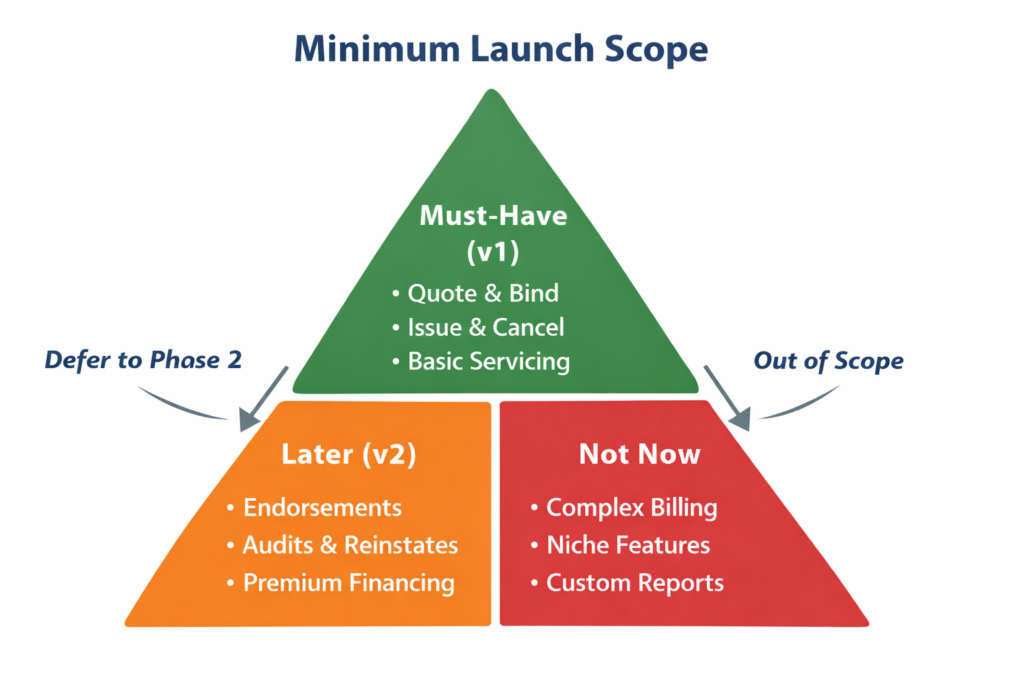
Market entry programs derail when a “new state launch” quietly becomes a rebuild of policy, billing, claims, portals, and support workflows. As edge cases pile up, time-to-market collapses.
You don’t need the entire enterprise workflow to launch a new state, only a thin slice that can quote, bind, issue, and service the most common transactions. A layered approach lets the legacy PAS/claims remain the system of record while a market-entry layer handles what changes fastest.
Minimum Launch Scope checklist
- Define v1 transactions: support, Quote, Bind, Issue, and include only essential servicing such as cancel/non-renew and basic contact changes, while pushing endorsements, audits, reinstatements, and premium finance to v2.
- Freeze non-critical features: publish a “not in v1” list so stakeholders stay aligned; when exceptions occur, route them through a documented manual process instead of expanding scope mid-launch.
- Lock one channel: Choose agency or MGA or direct for v1 so workflows, referrals, and portal journeys stay simple.
- Release as a package: Versioning forms, rating, and rules together with an effective date, so what you sell in production matches what you filed and tested.
- Build the runbook: Document the top 25 servicing scenarios and map steps across PAS, billing, portals, and support tools.
2. Map State Differences
A “new state launch” is rarely just cloning a product, because each jurisdiction introduces differences in forms, notices, rating constraints, underwriting rules, fees, and claims timelines. If those deltas are not mapped early, they surface late as rework across PAS, claims, billing, and portals.
State differences are primarily a rules, configuration, and versioning problem, not a reason to replace your core. You can keep the legacy PAS/claims as the system of record and manage state-by-state variations in a market-entry layer that controls product, rating, forms, workflows, and effective dates.
State Delta Map checklist
- Build a state delta map: Capture forms/notices, rating variables, underwriting/referral rules, taxes/fees, billing rules, and claims obligations, so everyone works from one source of truth.
- Version every delta: Treat each difference as state + line + effective date and link it to a versioned forms/rules/rate-table package, so production matches what was filed and approved.
- Add state gates: Block bind/issue when approvals are missing or not yet effective and generate the correct state-required documents automatically at issuance.
- Configure claims timelines: Set state-specific claims workflow SLAs, and align them to model expectations
- Verify producer eligibility: Validate producer licensing and appointments for the state/channel before quote or bind, and retain auditable proof using NAIC/NIPR producer licensing data sources.
3. Pick a Low-Disruption Approach
Market entry initiatives often stall when expansion is tied to a full core modernization program, introducing long timelines, migration risk, and cross-team dependency. What should be a growth initiative becomes a multi‑year transformation effort.
You can enter new markets without replacing your core by modernizing around it, not through it. A low‑disruption approach keeps the legacy PAS and claims systems as the system of record, while new market capabilities are added through a controlled, external layer that isolates change and reduces risk.
Low‑Disruption Approach checklist
- Adopt a layered pattern: Introduce a market‑entry layer that sits in front of the core, handling product, rating, workflows, and integrations, while the core continues issuing and recording policies.
- Route only new markets through the new layer: Keep existing books and workflows untouched and send only new state or product traffic through the modernized path.
- Expose the core through stable interfaces: Use APIs or service facades instead of modifying internal core logic, so changes do not ripple across billing, claims, or reporting.
- Isolate failure and rollback paths: Ensure new market issues can be contained or reversed without impacting existing policies or in‑force business.
- Expand incrementally: Add capabilities or states one at a time, based on stability and performance, rather than attempting a big‑bang rollout.
4. Move Product, Rating & Rules Outside the Core
Legacy core systems often hard-code rating, underwriting rules, and form logic, making even small product changes slow, error-prone, and dependent on full system releases. This limits speed and flexibility in launching or updating products across states.
You can externalize product/rating/rules so state changes become configuration updates, not core releases. The PAS can still store the issued policy, while an external engine owns rate calculations, UW rules, and form triggers by state/effective date.
Product, Rating & Rules checklist
- Externalize rating logic: Move rating tables, modifiers, and formulas to a standalone engine with state and effective-date versioning.
- Centralize underwriting rules: Use a rule engine to manage eligibility, referrals, and appetite controls outside the PAS.
- Decouple form logic: Generate forms dynamically using a versioned document service based on bound coverage and state rules.
- Pass clean outputs to core: Send final premium, selected terms, and document references to the PAS at bind time for record creation.
- Store decision objects: Log rating inputs, rule paths, and form selections with version IDs to support compliance and audit traceability.
5. Standardize Filings & Compliance
Filing delays and objections are one of the top reasons new market launches miss their target dates. Without structure, teams scramble to produce forms, rates, and supporting documentation that align with what’s in production.
Filing efficiency is a governance and versioning challenge, not a system limitation. You can build a repeatable, compliant “filing factory” that works alongside your existing PAS and claims systems.
Filing & Compliance checklist
- Standardize filing packages: Create a reusable template for forms, rates, rules, exhibits, and actuarial support tied to each product version.
- Use NAIC URS checklists: Run every package through the appropriate checklist before submission to reduce objections and speed up review.
- Track versions by effective date: Link every form, rule, and rate to its approved version and activation date, so production behavior matches filings.
- Log objections centrally: Maintain a single tracker for SERFF objections, responses, and correspondence to avoid delays and duplications.
- Align with release gates: Don’t allow production deployment in any state until filing approval is confirmed and effective.
6. Integrate at the Edges (Not the Core)
Integrating new products into legacy systems often requires deep changes to core code, leading to instability, regression risks, and long testing cycles across policy, billing, claims, and reporting modules.
Instead of modifying the core, you can integrate at the edges, exposing stable interfaces through APIs or events. This enables new product flows to connect with the PAS, billing, and claims systems without rewriting internal logic.
Edge Integration checklist
- Build an API layer: Wrap the PAS, billing, and claims systems with APIs for quote, bind, issue, payments, and FNOL, so new layers can interact without direct coupling.
- Use event-driven architecture: Send policy issuance, billing setup, and claims triggers as events to downstream systems for flexibility and traceability.
- Standardize portal-to-core workflows: Map portal actions to discrete service calls with validation, error handling, and audit logging.
- Avoid tight system dependencies: Keep new market-entry services loosely coupled from the core to prevent regression during updates or state expansions.
7. Start with a Simple Data Model
Teams often delay launches waiting for a perfect enterprise data model, but overengineering early leads to complexity, mismatched fields across systems, and endless data mapping debates.
You can launch with a thin, purpose-built data model that supports only what’s needed for quoting, binding, issuing, billing, and claims intake. The core remains the system of record, while the entry layer handles data shaping and translation.
Data Model checklist
- Define a minimal schema: Start with core entities like Account, Risk, Quote, Policy, Transaction, and Claim needed for end-to-end flow.
- Use stable IDs across systems: Assign persistent identifiers to link records between the entry layer, PAS, billing, and claims platforms.
- Map fields explicitly: Create translation rules between new-layer data and core system formats to avoid manual reconciliation later.
- Include effective dating logic: Track which version of rating, rules, and forms was applied at quote and bind time for compliance.
- Log data snapshots: Capture and store all quote inputs, rating outputs, and decision paths as immutable artifacts for audit and servicing.
8. Prepare Ops Docs & Support Workflows First
Even well-built quote and bind flows fail if servicing, underwriting, and support teams don’t have clear processes. Without documentation, minor issues escalate into delays, complaints, or compliance gaps.
Operational readiness is about processes, not platforms. You can launch using your existing PAS, billing, and claims systems, provided frontline teams have clear workflows, documentation, and escalation paths mapped across systems.
Ops Readiness checklist
- Define top service scenarios: List the 20-25 most common service requests (e.g., cancellations, document resend, payment status) and how each is handled.
- Map workflows to systems: Show where actions happen, PAS, billing, claims, portals, and what supporting data or tools are needed.
- Create support playbooks: Write step-by-step guides for service reps, including system navigation, response templates, and escalation triggers.
- Set up referral rules: Document underwriting referral thresholds, authority levels, and routing logic across channels.
- Prepare for exception handling: Design manual fallback steps for errors in quoting, billing mismatches, or document generation failures.
9. Set Triggers for Core Replacement
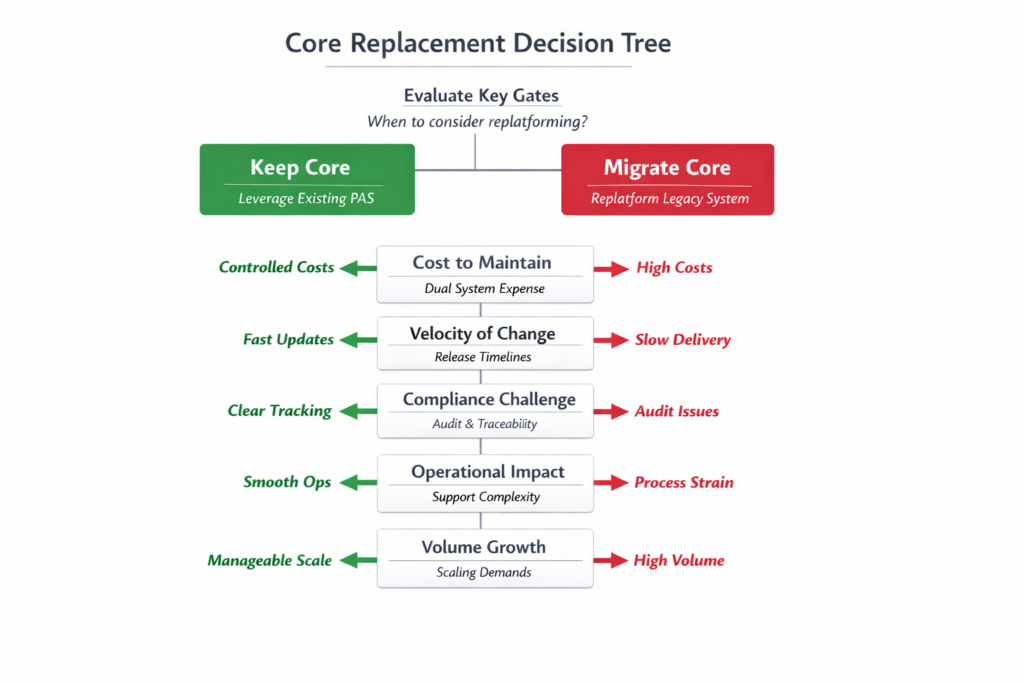
Many teams delay action waiting for a full core replacement, but large-scale restructuring often stalls due to budget, complexity, or shifting priorities, leaving growth plans on hold.
You can define objective triggers that tell you when core replacement becomes financially and operationally justified. Until then, the market-entry layer delivers growth without betting the company on a migration.
Core Replacement Triggers checklist
- Track velocity blockers: Replace core components only if they prevent timely updates to ratings, rules, or forms.
- Monitor dual-run costs: Compare the effort of maintaining both new and legacy paths against the cost of migration.
- Watch for audit friction: Replace if compliance traceability breaks across systems or requires excessive manual effort.
- Use volume milestones: Migrate core functions once new market traffic reaches stable scale and repeatability.
Why Replacing the Core Isn’t a Prerequisite
Every new state or product launch requires coordination across filings, forms, rating logic, compliance evidence, servicing workflows, and distribution. And yet, many insurers delay these launches unnecessarily, because they’re waiting for full core system replacements that may be years away.
- Speed-to-market is survival, not a luxury: P&C competitors adjust rates, forms, and appetite faster than ever; delays in launching mean lost premium and market share.
- State-by-state rules require precision: Filing timelines, form approvals, and rating constraints vary widely; sequencing launches without flexibility slows everything down.
- Regulators demand traceability: SERFF and NAIC tools expect submitted rates, rules, and forms to match what’s live; a mismatched system invites objections or exam issues.
- Big-bang core replacement is high-risk: Waiting for full restructuring can stall growth for years, while agile launch with lighter, faster architectures.
- A market-entry layer breaks the gridlock: It enables faster launches, better compliance control, and phased modernization without disrupting the stable core.
Conclusion
Successful expansion is less about replacing systems and more about building repeatable launch mechanics: clear scope, state deltas, disciplined filing alignment, configurable product logic, and frontline-ready workflows. Done this way, each new state becomes a controlled rollout, not a reinvention.
As an Insurtech consultant, Practo Insura helps carriers, MGAs, and TPAs operationalize across PAS, claims, billing, and digital portals, so growth stays compliant, scalable, and predictable.

We specialize in developing innovative Property & Casualty (P&C) insurance software solutions, leveraging over 8 years of InsurTech expertise to simplify insurance operations and enhance efficiency.
Share Article via


Subscribe to our insights newsletter
Related Blog Posts

Top 9 Claims Estimator Solutions...
 23 Sep, 2026
Claims estimating can involve significant manual work, from reviewing damage...
Read More

7 Signs Your P&C Insurance...
14 Aug, 2026
For U.S. P&C insurers, AI is shifting from a technology...
Read More
Insurance Underwriting Automation: Implementation Guide...
12 Jun, 2026
Most P&C underwriters did not join the industry to chase...
Read More