



For decades, U.S. auto insurance has relied on proxy-based pricing, using variables like age, ZIP code, credit score, and claims history to estimate risk. While effective at scale, this model has always been inherently imprecise. Two drivers with similar profiles can have very different real-world risk exposure yet pay nearly identical premiums.
Today, that gap is becoming more visible. Driving patterns have shifted significantly due to remote work, urban mobility changes, and evolving consumer behavior, but pricing models have not kept pace. Many low-mileage drivers are effectively overpaying, while insurers continue to operate on assumptions built around outdated usage patterns.
Pay As You Go (PAYG), or mileage-based insurance, addresses this disconnect by moving toward exposure-based pricing, where premiums reflect how much, how often, and how safely a customer drives. Instead of relying solely on historical or demographic proxies, insurers can now incorporate real driving data into pricing decisions.
State Farm also says drivers in its Drive Safe & Save program can save up to 30%, which shows how strongly usage-based pricing now resonates in the market.
Understanding Pay-As-You-Go (PAYG) in Auto Insurance
Pay As You Go (PAYG) auto insurance is a usage-based model where drivers pay premiums based on how much they actually drive, rather than a fixed annual estimate.
Instead of relying only on traditional factors like age or location, PAYG uses mileage (and sometimes driving behavior) to calculate cost, typically through a base fee + per-mile charge. This makes pricing more aligned with real exposure, especially for low-mileage drivers.
How PAYG Insurance Actually Works
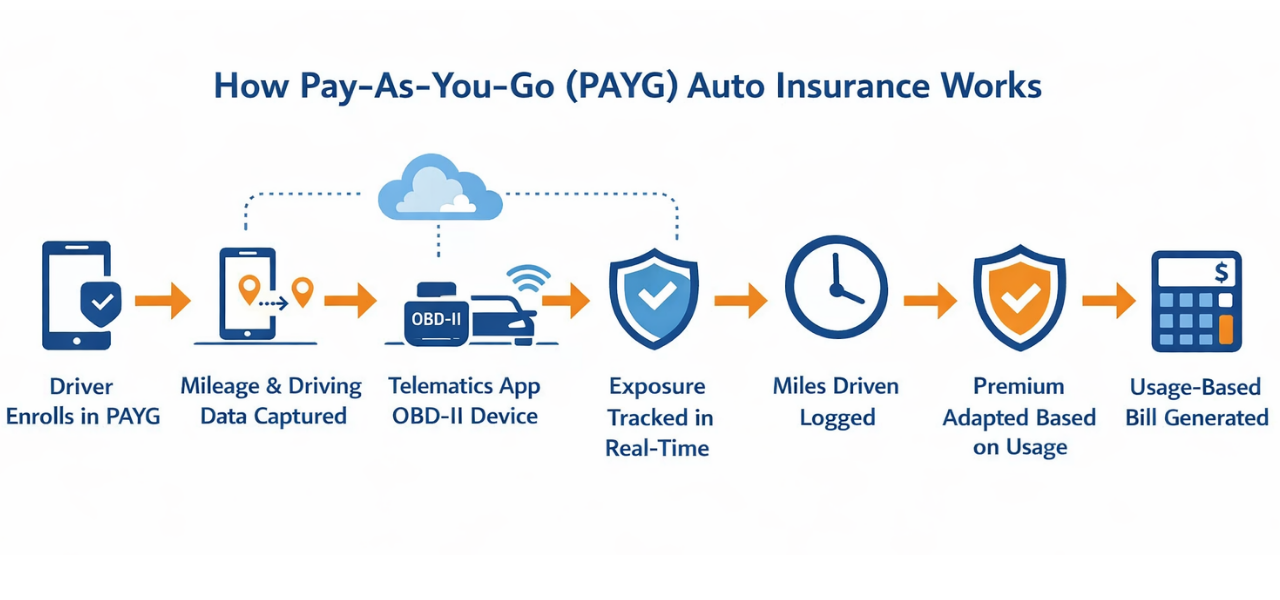
At a high level, PAYG auto insurance replaces a fixed premium with a usage-driven pricing structure, where coverage is continuously aligned with how much a vehicle is actually driven. Instead of pricing risk once at policy inception, insurers dynamically track exposure over time and calculate premiums accordingly.
The Core Workflow of PAYG
From an operational perspective, PAYG follows a relatively straightforward flow:
- The policyholder enrolls in a PAYG program via mobile app, telematics device, or OEM-integrated system.
- The insurer begins tracking mileage (and in some cases, driving behavior) in real time or near real time.
- Each trip contributes to total insured exposure during the billing cycle.
- At the end of the cycle, the premium is calculated based on total miles driven and applicable pricing rules.
- The customer receives a usage-based bill instead of a fixed monthly premium.
This creates a direct link between driving activity and cost, making the pricing model transparent and easier for customers to understand.
What Makes PAYG Different from Traditional Policies
The key difference is not just pricing, it is how exposure is defined and managed.
In traditional policies:
- Exposure is assumed upfront (annual mileage estimates)
- Pricing remains static until renewal.
- Customer interaction is minimal between billing cycles.
In PAYG:
- Exposure is measured continuously.
- Pricing reflects actual usage patterns.
- Customers interact more frequently through apps, usage updates, and billing visibility.
This transforms auto insurance from a static financial product into a dynamic, usage-based service.
Operational Challenges in PAYG Model
While the front-end experience appears simple, the underlying mechanics introduce complexity for insurers:
- Real-time or periodic data ingestion and validation
- Integration with policy administration and billing systems
- Handling edge cases (missed trips, device disconnects, manual corrections)
- Aligning usage data with regulatory-approved pricing structures
These factors make PAYG less about launching a new product and more about re-architecting core insurance workflows to support continuous exposure tracking.
Related Read: What Is Pay-As-You-Need Auto Insurance? How U.S. P&C Insurers Can Implement It.
Pricing Strategy & Monetization Model in Pay-As-You-Go Model
At the core of PAYG auto insurance is a shift from flat, assumption-based premiums to a hybrid pricing structure that directly aligns cost with actual usage. While the concept appears simple, designing a sustainable PAYG pricing model requires careful balancing between customer value and underwriting profitability.
Most PAYG programs operate on a two-component pricing structure:
- A fixed base rate
- A variable per-mile rate
The base rate covers non-driving risks such as theft, vandalism, weather-related damage, and administrative overhead. This ensures that the insurer maintains a minimum premium regardless of vehicle usage.
The per-mile rate, on the other hand, reflects actual exposure, charging customers only for the distance they drive. This rate is where insurers embed risk differentiation, adjusting for factors such as location, driving conditions, and historical risk profile.
This structure allows insurers to decouple ownership from usage, which is a fundamental departure from traditional models.
How PAYG Pricing Works
To understand how this works commercially, consider a typical comparison:
- Traditional policy: ~$120/month fixed
- PAYG model: ~$40 base fee + $0.05-$0.08 per mile
For a low-mileage driver (e.g., ~7,000–8,000 miles annually), the total monthly cost can drop significantly, often by 20–40%. For higher-mileage drivers, the cost approaches or exceeds traditional pricing, maintaining overall rate adequacy for the insurer.
This creates a self-segmentation effect:
- Low-mileage drivers are naturally attracted to PAYG
- High-mileage drivers may remain on traditional plans
However, this dynamic must be actively managed to avoid portfolio imbalance and adverse selection, a key pricing challenge for insurers scaling PAYG programs.
How Insurers Can Use Driving Behavior to Refine PAYG Pricing
While per-mile pricing seems linear, the underlying rate design is far more nuanced. Beyond mileage, leading PAYG programs incorporate behavioral scoring models to refine pricing further. This is where PAYG begins to move closer to full usage-based insurance (UBI).
Instead of charging purely based on miles driven, insurers evaluate how those miles are driven.
| Behavioral Factor | Pricing Impact |
|---|---|
| Hard Braking Score | Frequency/severity of braking events normalized by miles driven. High braking scores increase per-mile rate. |
| Time-of-Day Index | Percentage of miles driven in high-risk windows (midnight–5am, peak rush hours). Night driving can carry a 1.5x–2x per-mile multiplier. |
| Speeding Frequency | Percentage of miles driven above posted speed limit thresholds. Persistent speeding raises base rate at renewal. |
| Distraction Events | Phone interaction events per 100 miles. Used in some programs as a pricing modifier or as a coaching trigger. |
| Composite Behavior Score | Weighted aggregate of the above. Drives per-mile rate adjustment and renewal pricing recommendations. |
These inputs are aggregated into a composite driving score, which can influence pricing in two ways:
- Real-time or periodic rate adjustments
- Renewal-level repricing based on driving history
Additionally, insurers must define mileage caps, minimum charges, and billing thresholds to ensure predictable revenue and avoid extreme volatility in monthly premiums.
Technology & Ecosystem Layer Needed of PAYG (Pay-As-You-Go) Auto Insurance
PAYG auto insurance operates on a continuous data-to-pricing pipeline, which requires insurers to move beyond traditional, batch-driven systems. Unlike standard auto products where pricing inputs are fixed at policy inception, PAYG depends on ongoing data ingestion, processing, and rating updates throughout the policy lifecycle.
To enable this, insurers need a connected ecosystem that links telematics data with core insurance systems in a structured and reliable way.
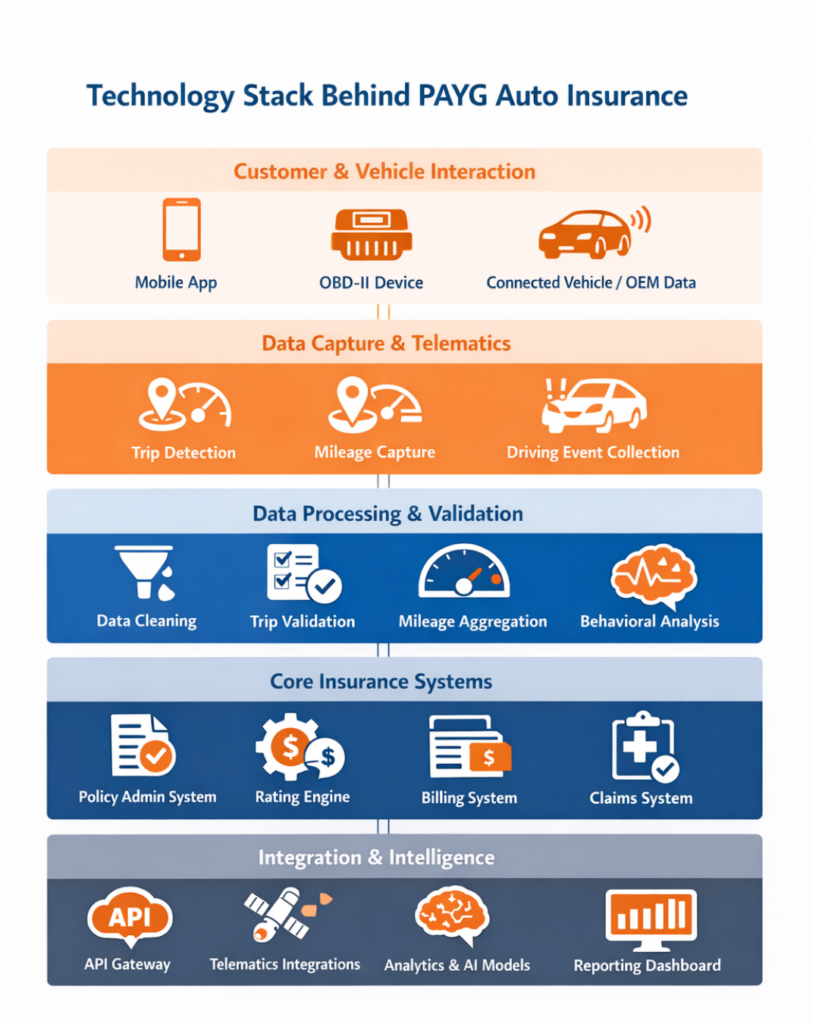
1. Data Capture Layer
This is the entry point of the PAYG model, where driving data is collected. Insurers typically rely on a mix of:
- Mobile-based telematics: scalable and cost-efficient, widely used for rapid rollout
- OBD-II devices: higher accuracy and consistency, but with hardware overhead
- OEM-connected vehicle data: increasingly important as embedded telematics becomes standard
Many insurers adopt a multi-source strategy to balance cost, accuracy, and customer adoption. The choice of data sources directly impacts pricing precision and operational complexity.
2. Data Processing & Validation Layer
Raw telematics data is not immediately usable for pricing. It must be normalized, validated, and structured before being passed into rating systems.
This layer typically handles:
- Trip detection and correction (e.g., filtering false positives)
- Mileage reconciliation across devices or sessions
- Aggregation of exposure data over billing cycles
- Basic behavioral signal extraction (if applicable)
This is a critical control point; inaccurate data directly translates into pricing errors, which can impact both customer trust and regulatory compliance.
3. Core Insurance Systems Integration
PAYG fundamentally changes how core systems operate.
Key systems involved include:
- Policy Administration System (PAS): Must support dynamic exposure inputs instead of fixed annual assumptions
- Rating Engine: Applies base + per-mile pricing logic and, in some cases, behavioral modifiers.
- Billing System: Generates variable, usage-based invoices rather than fixed premiums.
The challenge is that most legacy systems were designed for static rating and predictable billing cycles. PAYG requires these systems to handle frequent updates, variable charges, and flexible billing logic.
4. API & Integration Layer
The entire PAYG ecosystem is held together by APIs that enable seamless data exchange.
This layer supports:
- Integration with telematics vendors and OEM platforms
- Data flow between external systems and internal core platforms
- Scalability across multiple states and regulatory configurations
A well-designed API layer allows insurers to avoid tight coupling between systems, making it easier to evolve the PAYG model over time.
Related Read: Top 7 Usage-Based Insurance Trends for Auto Insurers in USA
Technology Approach by Insurer Size
The success of PAYG is not determined by pricing design alone, it depends on how well insurers can operationalize continuous data within their existing architecture.
| Insurer Type | Technology Approach | Key Focus Areas | Difficulty | Priority |
|---|---|---|---|---|
| Large National Carriers | Build + Partner (proprietary platforms + OEM integrations) | In-house data pipelines, ML models, deep core system integration, real-time pricing | High | High |
| Mid-Size / Regional Insurers | Vendor-led + API integration | Telematics platforms, PAS integration, faster rollout, controlled investment | Medium | High |
| MGAs / Digital-First Insurers | Fully API-driven, modular stack | Third-party infrastructure, rapid product launch, niche segmentation, minimal legacy dependency | Low–Medium | Medium–High |
Risk Management in PAYG (Pay-As-You-Go) Auto Insurance
Underwriting Considerations for PAYG Model
PAYG requires underwriting to shift from static risk assessment to continuous exposure evaluation. Instead of relying primarily on demographic and historical proxies, risk is increasingly tied to actual usage patterns, how much the vehicle is driven, when, and under what conditions.
Key underwriting adjustments include:
- Exposure-based segmentation: Risk is grouped based on mileage bands (low, medium, high usage) rather than only traditional variables.
- Dynamic risk visibility: Insurers gain ongoing insight into how exposure evolves over time, enabling more informed portfolio management.
- Behavior-informed underwriting (where applicable): Driving patterns can be used to refine risk classification beyond mileage alone.
- Portfolio-level monitoring: Loss ratios are tracked across usage segments to identify underperforming cohorts early.
- Closer actuarial alignment: Pricing, underwriting, and actuarial teams must operate in sync due to continuous data inputs.
To maintain profitability, auto insurers must focus on:
- Per-mile rate adequacy across segments
- Balanced portfolios mix between PAYG and traditional policies.
- Adverse selection control, especially during early adoption phases
In PAYG, underwriting becomes less about predicting risk once and more about continuously validating and adjusting it over time.
Claims Handling in a PAYG Environment
PAYG does not fundamentally change the claims lifecycle, but it introduces new validation layers and operational dependencies that insurers must account for. Traditional claims systems remain relevant, but they need to be adapted to work with intermittent coverage and data-driven exposure.
Below are the key considerations insurers must address:
1. Coverage Validation at Time of Loss
Unlike traditional auto policies where coverage is continuous, PAYG requires insurers to validate whether coverage was active at the exact time of the incident. This introduces a critical dependency on policy activation status, trip timing, and system synchronization, making coverage verification a foundational step in every claim.
2. Trip-Level Incident Verification
PAYG enables claims teams to go beyond customer-reported information by using trip data such as start time, end time, route, and mileage. This adds a layer of objectivity to claims validation but also requires insurers to ensure that trip data is accurate, complete, and properly linked to claims records.
3. Telematics-Driven Claims Enrichment
In more advanced implementations, telematics data can enhance claims assessment by providing driving context at the time of loss, such as speed or braking behavior. While not mandatory for all PAYG models, this capability allows insurers to move toward more data-informed severity assessment and faster FNOL processes.
4. Fraud Detection Recalibration
PAYG changes both the nature of fraud risk and the tools available to detect it. Claims that do not align with recorded trips or fall outside active coverage windows can be flagged early. At the same time, insurers must account for new manipulation risks around trip activation and data gaps, requiring updated fraud detection frameworks.
5. Handling Data Gaps and Disputes
One of the biggest operational shifts in PAYG is managing scenarios where trip data is missing, incomplete, or disputed by the customer. Insurers must define clear fallback rules, escalation paths, and communication strategies to handle these cases without creating friction or regulatory exposure.
6. Claims Segmentation by Usage Patterns
PAYG allows insurers to analyze claims performance across different mileage bands and usage behaviors, rather than treating all policyholders uniformly. This creates an opportunity to better understand frequency and severity trends tied to actual exposure, improving both pricing and underwriting decisions over time.
7. Integration with Core Claims Systems
Traditional claims platforms must be extended to support PAYG by integrating with telematics providers, trip data systems, and policy activation engines. Without seamless integration, claims handling can become fragmented, leading to delays and inconsistent decision-making.
In PAYG, claims management evolves from a reactive process into a data-validated decision layer. Insurers that align claims with exposure data can improve accuracy, reduce fraud, and enhance customer trust, while those that rely on traditional processes risk operational inefficiencies and disputes.
Regulatory & Compliance Landscape
PAYG auto insurance does not operate in a uniform regulatory environment. Auto insurance in the United States is regulated at the state level, making PAYG deployment a complex, multi-jurisdiction exercise.
Unlike many insurance innovations that face a single regulatory environment, PAYG insurers must navigate 50 different frameworks for rate filing, data use, and consumer disclosure. The regulatory landscape can be broadly categorized into three tiers:
- Progressive States: California, Colorado, Illinois, and New York, which are actively supporting UBI. California’s Prop 103 framework has been interpreted to allow telematics data as a rating factor, though strict anti-discrimination rules apply.
- Neutral States: Texas, Florida, Georgia, and Ohio, which are permissive frameworks that neither specifically enable nor restrict PAYG. Rate filings are approved case-by-case. Most major PAYG programs operate here.
- Restrictive/Unclear States: Michigan, Montana, and Hawaii, which are complex or outdated frameworks that create regulatory uncertainty. Some states have legacy rules that make per-mile pricing difficult to file.
Rate Filing Requirements to Consider in PAYG Model
For carriers launching or expanding PAYG programs, state rate filing is the critical path item. Key considerations:
- Most states require actuarial justification for telematics rating factors. This means you need sufficient internal or industry data to demonstrate the statistical relationship between behavioral variables and claims outcomes.
- Some states require filing the telematics scoring algorithm itself, raising IP protection concerns. Carriers have managed this through proprietary algorithm filings with confidentiality protections.
- Rate changes based on behavioral scores may require re-filing in some states. Build your product architecture to accommodate state-specific constraints on dynamic re-pricing.
6 Key Regulatory and Compliance Considerations for PAYG Auto Insurance
- Telematics data is sensitive personal data: PAYG collects mileage, location, trip timing, and driving behavior, so insurers need strong privacy and governance controls.
- State privacy laws directly affect PAYG operations: Laws such as CCPA/CPRA in California and similar rules in states like Virginia, Colorado, Connecticut, and Texas require clear consent, transparency, and data handling processes.
- Location data needs stricter controls: GPS data can reveal personal routines and may face added regulatory restrictions, especially if used in pricing.
- Auditability and consent are essential: Insurers should document what data is collected, how it is used and maintain clear audit trails for pricing and compliance review.
- Anti-discrimination risk must be monitored: Variables like route data or night driving can unintentionally create disparate impact, so fairness testing should be built into model governance.
- Ongoing compliance reviews are becoming important: PAYG models should be reviewed regularly to ensure they remain explainable, justified, and aligned with evolving regulatory expectations.
How Does Customer Strategy Differ in PAYG (Pay-As-You-Go) Insurance?
PAYG (Pay-As-You-Go) insurance changes customer strategy from a one-time policy sale to an ongoing usage-driven relationship model. Unlike traditional auto insurance, where acquisition and renewal are the primary touchpoints, PAYG requires insurers to continuously engage customers based on how, when, and how much they drive.
Target Customer Segments for PAYG
PAYG does not work equally well for all drivers. Its value is strongest for specific segments where usage is lower or more variable:
- Low-Mileage Urban Drivers: Typically drive less than ~8,000 miles annually and rely on alternative transport. Highly price-sensitive and a strong fit for PAYG.
- Remote Workers & Retirees: Reduced or irregular commuting patterns make traditional annual premiums inefficient for this group.
- Multi-Car Households: Secondary or backup vehicles often have low utilization but are overpriced under standard policies.
- Young Drivers (18–25): High traditional premiums create strong incentives to adopt PAYG, especially if driving is limited or safe.
- EV Owners: More comfortable with digital tools and telematics and often exhibit lower or more predictable usage patterns.
How to Acquire Customers in a Competitive PAYG Market
With most major carriers already offering PAYG programs, acquisition depends on clarity, personalization, and accessibility:
- Personalized Savings Calculators: Showing a direct comparison between PAYG and current premiums is one of the most effective conversion tools.
- Embedded Distribution Partnerships: Integrating PAYG into ecosystems like vehicle purchase journeys, mobility apps, or EV charging networks helps capture customers at the moment of need.
- Agent Enablement: Agents may under-sell PAYG due to complexity or lower upfront premiums. Simplified workflows, clear messaging, and retention-based incentives can improve adoption.
How Insurers Can Keep PAYG Customers Engaged
PAYG creates more frequent interaction points compared to traditional insurance, turning the product into a continuous engagement platform:
- Regular Driving Insights: Weekly summaries of mileage, driving behavior, and estimated costs help build transparency and habit.
- Personalized Safety Feedback: Data-driven insights can guide safer driving while reinforcing value.
- Milestone-Based Rewards: Recognizing safe or low-usage behavior through discounts or incentives improves retention.
- Behavior-Based Reviews Instead of Static Renewals: Showing customers how their behavior impacted savings creates a stronger renewal narrative.
Well-executed engagement strategies have been shown to reduce churn significantly, as engaged policyholders are more likely to stay and refer others.
3 Key Challenges in PAYG Retention
While PAYG improves engagement, it can also introduce new risks if not designed carefully:
- Billing Volatility (Bill Shock): Sudden increases in usage can lead to unexpectedly high charges. Usage alerts and billing smoothing options can help manage expectations.
- Evolving Privacy Concerns: Customers may reassess their comfort with telematics over time. Offering flexible data-sharing options helps maintain trust.
- Price-Based Switching: Low-mileage drivers are highly attractive to competitors. Retention cannot rely only on pricing, experience and engagement must play a role.
Related Read: 6 Types of On Demand Auto Insurance and Who They Fit Best
PAYG Readiness Framework: Actionable Scorecard
Use this framework to evaluate how prepared your organization is to design, launch, and scale a PAYG product across core operational areas:
| Domain | Early Stage | Developing | Advanced |
|---|---|---|---|
| Technology & Data | No telematics capability; relies on proxy data (ZIP, age, vehicle) | Pilot telematics program; single data source (app or device) | Multi-source telematics (app, OEM, APIs); ML-based risk scoring; real-time data pipelines |
| Pricing & Underwriting | Traditional annual pricing; no usage-based rates filed | Per-mile or basic usage pricing filed in select states; initial actuarial validation | Dynamic behavioral pricing; trip-level risk scoring; cohort-based loss monitoring; fraud detection models |
| Regulatory & Compliance | Ad hoc compliance approach; limited privacy governance | Rates filed in key states; basic consent and privacy framework | Federated state compliance model; strong data governance; audit-ready documentation; fairness testing |
| Customer Strategy | PAYG offered as niche add-on; limited awareness or engagement | Active acquisition strategy (calculators, digital channels); basic app engagement | Full lifecycle engagement (insights, rewards, coaching); embedded distribution; high retention focus |
Conclusion
PAYG is moving beyond experimentation and becoming a more credible path for auto insurers that want sharper pricing and stronger product differentiation. The broader usage-based insurance market is projected to grow from $43 billion in 2023 to $149 billion by 2030, showing that usage-linked models are gaining real momentum.
That is why PAYG should be built as a strategy, not just launched as a feature. It requires insurers to align product design, exposure-based underwriting, telematics infrastructure, compliance controls, and customer engagement into one model.
This is where insurance strategic consultant such as Practo Insura can help carriers, MGAs, and brokers shape the right PAYG approach end-to-end, from product and pricing strategy to underwriting frameworks, infrastructure planning, regulatory readiness, and go-to-market execution. In the long run, the winners in PAYG will not be the ones who simply launch first but the ones who build it to scale.

We specialize in developing innovative Property & Casualty (P&C) insurance software solutions, leveraging over 8 years of InsurTech expertise to simplify insurance operations and enhance efficiency.
Share Article via


Subscribe to our insights newsletter
Related Blog Posts

How to Reduce FNOL Time...
 05 Oct, 2026
A homeowner discovers a burst pipe at 11 p.m. If...
Read More

Top 9 Claims Estimator Solutions...
23 Sep, 2026
Claims estimating can involve significant manual work, from reviewing damage...
Read More

7 Signs Your P&C Insurance...
14 Aug, 2026
For U.S. P&C insurers, AI is shifting from a technology...
Read More